Category Archives: Asian Credit News

Enterprise Financing Credit Platform | Deputy Director of the National Development and Reform Commission, Li Chunlin: Providing More Accurate Financing Services to Specialized Industries

During the State Council’s regular policy briefing held by the State Council Information Office on April 10th, Li Chunlin, Deputy Director of the National Development and Reform Commission, introduced the long-standing issues faced by small and medium-sized enterprises (SMEs) and private enterprises, such as difficulties and high costs in financing.

Li Chunlin stated that many of these enterprises are in their early stages or growth phases, often lacking effective collateral and guarantees, making it difficult to meet the loan requirements of traditional credit models, as they lack tangible assets as loan collateral. Financial institutions providing credit financing services need to assess the credit levels of enterprises based on their credit information. However, this credit information is often dispersed and difficult to obtain, limiting financial institutions’ ability to grant credit loans based on information. Banks, especially when providing loans to SMEs, startups, and even student entrepreneurs, lack comprehensive understanding of their overall credit and asset situations. With individual pieces of information scattered across different departments, this is a significant bottleneck and a major pain point.

To address this pain point, the National Development and Reform Commission has established a national financing credit service platform to help SMEs exchange credit for loans by strengthening the application of credit information sharing. The platform mainly has four major functions:

I. Credit Information Inquiry

The platform has already collected over 78 billion pieces of credit information and provides information inquiry services to financial institutions based on the principle of public welfare, alleviating the problem of information asymmetry between banks and enterprises. As of now, the platform has provided inquiry services to relevant financial institutions over 276 million times, with an average weekly visit volume exceeding one million people. It has collected credit information on 17 major categories and 37 items of operating entities.

II. Financing Demand Matching

Intelligently matching the financing needs of operating entities with the financial products provided by banking institutions to achieve nationwide financing supply-demand matching services. The “Financial Supermarket” section has launched 22 financing service products for operating entities to choose from independently.

III. Direct Access to Enterprise-Friendly Policies

Concentrating on displaying various enterprise-friendly financial support policies, the first batch of 35 local enterprise-friendly policies can be applied for online. Enterprise-friendly financial policies scattered across various government departments can be queried on this platform, allowing operating entities to find suitable or eligible policies for application.

IV. Financing Credit Enhancement Services

Introducing financing guarantee institutions and risk-sharing funds, the first batch of 20 local credit enhancement and risk mitigation services can be processed on the platform in a “one-stop” manner.

Li Chunlin explained that currently, relying on the national integrated financing credit service platform network, a new inclusive financial model based on credit information has been cultivated, and a comprehensive financing service system covering the entire process has been established, providing SMEs, especially private enterprises, with convenient financing channels.

Corporate Financing Credit Platform | Director of the Central Bank’s Credit Bureau, Ren Yongmei: Supporting credit institutions in utilizing big data and artificial intelligence for product innovation

The State Council Information Office held a regular policy briefing on April 10, 2024 (Wednesday) at 3:00 PM, where Li Chunlin, the Deputy Director of the National Development and Reform Commission, Ren Yongmei, Director of the Credit Bureau of the People’s Bank of China, and Feng Yan, the head of the Inclusive Finance Department of the Financial Regulatory Authority, introduced the ‘Implementation Plan for Coordinating the Construction of Financing Credit Service Platforms to Improve the Financing Convenience Level of Small and Micro Enterprises’ and answered questions from reporters. Below is the transcript of the Q&A session with Ren Yongmei, Director of the Credit Bureau of the People’s Bank of China:

Reporter from Poster News: In recent years, market-oriented credit institutions in our country have developed rapidly and have played an important role in enhancing the efficiency of credit financing matching. Could you please share the People’s Bank of China’s considerations on cultivating and managing the credit market? Thank you.

Thank you for the question, let me answer it. First, I appreciate your concern and support for the credit market. The construction of our country’s credit system has always adhered to a dual-drive approach of ‘government + market,’ and market-oriented credit institutions are an important part of China’s credit system. In recent years, the People’s Bank of China has vigorously developed a multi-level credit market, covering a wide range of social credit needs. First, we have actively and prudently developed the personal credit market. According to market demands and in conjunction with personal information protection requirements, the People’s Bank has approved two personal credit institutions. In 2023, these institutions provided various credit services such as credit reports, credit scores, and anti-fraud scores, totaling 42 billion times. Second, we nurture and develop the corporate credit market. We guide institutions with data, technology, and markets to enter the corporate credit market, integrating various types of credit information related to enterprises’ registration, business operations, and contract fulfillment. In 2023, 149 corporate credit institutions provided various credit services 22.3 billion times. Third, we have actively promoted the market-oriented transformation of local credit platforms, achieving significant results. Out of 31 provincial local credit platforms, 26 are operated by specially established market-oriented institutions. These institutions comprehensively collect local enterprises’ public credit information and other commercial credit data, achieving deep integration and application of various types of information to provide specialized credit services to financial institutions.

Next, the People’s Bank will follow the Central Committee’s decisions on building a comprehensive social credit system, fully implement the deployment requirements of the ‘Implementation Plan,’ and continue to nurture and manage the credit market. First, further optimize the layout of the credit market. Seize the development opportunities of new productive forces, deepen credit supply-side reforms, support credit institutions in using new technologies like big data and artificial intelligence for product innovation, and provide diversified and differentiated credit information services for inclusive financial development. Second, further promote the sharing and application of various types of credit information. In conjunction with the Development and Reform Commission, we will promote the legal and compliant opening of data to credit institutions by the credit information platform, fully leveraging the multiplier effect of data. Third, continuously strengthen credit supervision. Firmly implement strict supervision requirements, bring all credit activities under lawful regulation, and comprehensively protect the legal rights and information security of information subjects. Thank you.

China News Agency reporter: The “Implementation Plan” proposes that the Financial Credit Information Basic Database should adhere to the positioning of financial infrastructure and provide high-quality specialized credit services for financial institutions. I would like to inquire about the effectiveness of the National Financial Credit Information Basic Database in supporting financing for small and medium-sized enterprises (SMEs). What are the considerations for the next steps? Thank you.

Thank you for the question. I’ll address it. The People’s Bank of China (PBOC) resolutely implements the decisions and arrangements of the Central Committee of the Communist Party of China and the State Council, continuously improves the policy system of financial services for the real economy, and vigorously promotes the construction of the credit system, which has played a positive role in alleviating the difficulties and high costs of financing for small and medium-sized enterprises (SMEs). The PBOC began building the financial credit system in the 1990s. After nearly thirty years of development, the National Financial Credit Information Basic Database has grown from nothing to the largest credit system in the world in terms of coverage and the most comprehensive in terms of credit information. Querying the database for credit reports has become a necessary step in the credit review process of financial institutions, playing a leading role in financial services for the real economy.

Here are some numbers for reference: As of the end of March 2024, the database has been accessed by 6,124 legal entities engaged in credit business, including commercial banks, consumer finance companies, and microloan companies. It has recorded information related to 1.16 billion individuals, 130 million households, and other organizations. In 2023, the database provided query services 5.3 billion times, a significant number indicating the substantial support for financing obtained by many SMEs with good credit history. In the World Bank’s Doing Business assessment, China’s credit information index, with the database as a reference, has ranked among the top globally for several consecutive years.

Furthermore, the PBOC actively promotes the construction of the unified registration and public announcement system for movable property financing and the accounts receivable financing service platform, which has facilitated the financing development of SMEs. As of the end of March 2024, the unified registration and public announcement system for movable property financing has handled 34.455 million registrations and provided 210 million queries. The accounts receivable financing service platform has facilitated 512,000 financings. It is fair to say that significant progress has been made in supporting movable property financing and supply chain finance.

In the next steps, the PBOC will thoroughly implement the spirit of the Central Economic Work Conference and the Central Financial Work Conference, practice the concept of “credit for the people,” continuously improve the database’s functions and services, and provide information support for the five major tasks. First, it will lawfully and comprehensively collect financial credit information, deepen the development and application of credit information, further improve service quality and efficiency, and support financial institutions in establishing a sound and effective mechanism for lending. Second, it will research and promote the shared application of payment fund flow information for SMEs, form a complementary service pattern with credit information, and further enhance the financing convenience for SMEs without credit records. Third, it will further expand the registration scope of the unified registration and public announcement system for movable property financing, and promote the application of the accounts receivable financing service platform, helping SMEs obtain financing using movable property. Thank you!

Notice of the General Office of the State Council on Issuing the ‘Implementation Plan for Coordinating the Construction of Financing Credit Service Platforms to Improve the Financing Convenience Level of Small and Micro Enterprises

Notice from the General Office of the State Council on Issuing the ‘Implementation Plan for Coordinating the Construction of Financing Credit Service Platforms to Improve the Financing Convenience Level of Small and Micro Enterprises’

State Council Office Issue [2024] No. 15

To the People’s Governments of all provinces, autonomous regions, and municipalities directly under the Central Government, and to all ministries and commissions of the State Council, and to all directly subordinate institutions:

The ‘Implementation Plan for Coordinating the Construction of Financing Credit Service Platforms to Improve the Financing Convenience Level of Small and Micro Enterprises’ has been approved by the State Council and is now issued to you for serious implementation.

General Office of the State Council

March 28, 2024

(This document has been abridged)

Coordinated Construction of Financing Credit Service Platforms

Implementation Plan to Enhance Financing Convenience for Small and Micro Enterprises

The financing credit service platform is a comprehensive platform established under the guidance of government departments. It aggregates credit information across sectors and fields to provide credit information services for financial institutions’ enterprise financing activities. It plays a crucial role in solving the problem of information asymmetry between banks and enterprises and in reducing the financing costs for businesses. To implement the decisions and deployments of the Central Committee of the Communist Party and the State Council, better coordinate the construction of financing credit service platforms, improve the inclusive financing service system based on credit information, and effectively enhance the financing convenience level for small and micro enterprises, this implementation plan has been formulated.

I. Overall Requirements

Guided by Xi Jinping’s Thought on Socialism with Chinese Characteristics for a New Era, fully implement the spirit of the Party’s 20th National Congress, thoroughly, accurately, and comprehensively apply the new development concepts, accelerate the construction of a new development pattern, strive to promote high-quality development, improve the data foundation system, increase the coordination efforts in building financing credit service platforms, perfect the mechanism for the aggregation and sharing of credit information, advance the ‘Credit Easy Loan’ initiative, deepen the application of credit big data, ensure information security and the legitimate rights and interests of business entities, prompt financial institutions to change their business philosophies, optimize financial services, and control financial risks, providing high-quality financial services especially for small and micro enterprises.

II. Increase Coordination Efforts for Platform Construction

(i) Clarify the channels for the aggregation and sharing of credit information. Strengthen the ‘main hub’ function of the national credit information sharing platform (hereinafter referred to as the credit information platform) for the aggregation and sharing of credit information, and enhance the data sharing of the national financial credit information base database. The credit information platform unifies the collection of various types of credit information and shares it with departments and localities as needed. Relying on the credit information platform, construct a national financing credit service platform and connect it with local financing credit service platforms to form a nationwide integrated platform network. This serves as the ‘sole outlet’ for providing public credit information services to financial institutions, although the provision of credit information services in specific fields by departments to financial institutions is not restricted by this. Adhere to the financial infrastructure positioning of the national financial credit information base database, providing high-quality professional credit services to financial institutions.

(ii) Strengthen the integration and unified management of local platforms. Integrate local financing credit service platforms that are redundant or inefficient, keeping only one provincial platform per province in principle, and no more than one platform at the city or county level. All local platforms should be unified into the national integrated platform network, managed through a list-based approach to reduce redundant construction and waste of resources. The National Development and Reform Commission is responsible for coordinating the construction of financing credit service platforms and promoting the integration and unified management of local platforms. All regions should complete the platform integration by the end of December 2024, orderly managing asset transfer, data handover, and personnel placement, ensuring that platform services are not affected during the integration period.

(iii) Enhance guidance for the construction of local platforms. Standardize the criteria for local financing credit service platforms to access the national integrated platform network, optimize credit information services, and promote the standard and healthy development of local platforms. Relying on urban credit monitoring and the creation of social credit system demonstration zones, strengthen guidance on improving platform data quality. Fully utilize the existing counterpart support mechanisms to further deepen cooperation in constructing financing credit service platforms between the eastern and the central and western regions, and accelerate the ‘Credit Easy Loan’ initiative in the central and western regions.

III. Optimize the credit information collection and sharing mechanism

(iv) Clarify the scope of credit information collection and sharing. Based on the actual needs of financial institutions for credit information, further expand the scope of credit information collection and sharing to include key personnel information of enterprises, various qualification information, import and export information, etc., into the credit information collection and sharing list (see attachment). The National Development and Reform Commission will lead the timely update of this list. All regions should fully utilize the role of local financing credit service platforms to break down data barriers, legally and regulatively increase the collection and sharing of credit information outside the list, compile provincial credit information collection and sharing lists in line with local realities, and effectively expand the breadth and depth of data collection and sharing.

(v) Improve the quality and efficiency of credit information sharing. Increase ‘total-to-total’ sharing efforts for credit information already managed centrally by national departments. Strengthen collaborative governance of data quality, standardize data collection standards, timely conduct credit information repair, and improve information update and maintenance mechanisms to ensure data is true, accurate, and complete. Address issues such as insufficient data sharing frequency, inadequate interface capacity, and insufficient sharing of certain public utility information to further enhance the efficiency of credit information sharing. According to the needs of data providing units, regularly feedback on data usage and effectiveness. The National Development and Reform Commission should lead the assessment of credit information sharing quality and efficiency among regions and relevant departments.

IV. Deepening the Utilization of Credit Data

(vi) Improve information query services. Financing credit service platforms at all levels should provide services such as information push, information queries, and credit report queries to financial institutions according to the principles of public welfare, in accordance with laws and regulations. They should expand the scope of credit information queries, refine the credit report query system, and enhance the quality of credit reports. Support banking institutions in perfecting credit management systems and increasing the use of credit reports in customer screening, pre-loan investigations, in-loan approvals, and post-loan management, thereby providing high-quality financial services to small and micro enterprises.

(vii) Conduct joint modeling applications. Support financing credit service platforms and financial institutions in establishing joint laboratories for credit information collection and processing. Enhance sensitive data development and application through measures such as ‘keeping data within domain’, and improve the level of financial credit joint modeling. Encourage financial institutions to actively connect with financing credit service platforms and fully utilize credit information to optimize credit product development, credit evaluation, and risk management.

(viii) Develop credit financing products. Fully leverage the credit information aggregation advantages of key enterprises, centralized trading places, and distinctive industrial clusters. Conduct “Credit Easy Loan” special product pilots adaptively. Enhance the application of comprehensive public credit evaluation results, encourage local financing credit service platforms to develop strategic new industries, future industries, green and low-carbon development, key industrial and supply chains, agriculture-related modules, and support financial institutions in utilizing specialized credit information to launch market-oriented financial products and services in niche areas. Accelerate the construction of the rural credit system, support financial institutions in developing exclusive financial products and services for farmers and new types of agricultural operators, and moderately increase the proportion of credit loans.

(ix) Expand and enhance platform service functions. Encourage localities to establish and improve a “policy-to-person” mechanism, fully leverage the advantages of local financing credit service platforms in connecting enterprises and financial institutions, and promote the direct delivery of various financial convenience and enterprise-benefiting policies to small and micro enterprises and other business entities through the platform. Promote financing guarantee institutions to join the financing credit service platforms, establish a multi-party cooperation mechanism involving banks, governments, and financing guarantee institutions based on the platform, and simplify related financing guarantee procedures rationally. Encourage capable localities to establish mechanisms such as “online notarization,” “online arbitration,” and financial internet courts based on financing credit service platforms, for efficient resolution of financial disputes.

(x) Develop the credit service market. Establish operating conditions and standards for the credit information platform. Under the premise of ensuring information security, legally and regulatively open data to various credit service institutions, including credit reporting agencies, steadily foster the credit service market, and enhance the efficiency of matching supply and demand in credit financing.

V. Safeguard Measures

(xi) Strengthen information security and protect the rights and interests of information subjects. Enhance the management of information security on financing credit service platforms, improve management norms and standards for platform integration, institution entry, information collection, information sharing, and data security, and effectively ensure the security of physically collected information. Financing credit service platforms at all levels should strengthen the management of information authorization, enhance the security of data sharing, use, transmission, and storage, improve the monitoring and early warning of security risks, and effectively safeguard data security. Without anonymization or explicit authorization from the information subjects, financing credit service platforms at all levels must not provide information involving trade secrets or personal privacy, nor may they illegally spread, leak, or sell relevant credit information.

(xii) Strengthen policy support and safeguards. Local people’s governments should provide appropriate support for the construction of local financing credit service platforms at their level, guide local platforms and financing guarantee institutions to strengthen cooperation, and enhance the level of financing convenience for small and micro enterprises. Encourage localities to develop incentive policies that support credit financing, and provide appropriate incentives to financial institutions that help small and micro enterprises achieve financing through financing credit service platforms.

The third personal credit rating license may accelerate implementation; what impact will this have on the industry?

The third personal credit license may be issued soon!

Pan Gongsheng, the governor of the People’s Bank of China, recently announced at a press conference held by the State Council Information Office that the People’s Bank is guiding Qiantang Credit in its application for a personal credit license in conjunction with the Zhejiang Provincial Government.

Compared to Baihang Credit and Pudao Credit, which are already operational, Qiantang Credit has faced a much more difficult journey in applying for the personal credit license. As early as November 26, 2021, the People’s Bank had announced that it had accepted Qiantang Credit’s application for personal credit services. More than two years have passed, and the People’s Bank has still not issued a decision.

The challenging path for Qiantang Credit’s license application may be influenced by the ‘direct connection interruption’ and major shareholder restructuring. From the perspective of equity structure, both Zhejiang Tourism Investment Group Co., Ltd. (referred to as ‘Zhejiang Tourism Group’) and Ant Technology Group Co., Ltd. (referred to as ‘Ant Group’) hold 35% stakes, making them the largest shareholders.

As the restructuring of Ant Group is essentially complete and policy signals are clear, the issuance of Qiantang Credit’s personal credit license may accelerate. Several industry experts have stated that the issuance of Qiantang Credit’s personal credit license is of positive significance to the industry and will help align personal credit infrastructure with the development of the digital economy.

Qiantang Credit’s Challenging Path to Licensing

Ant Group’s application for a personal credit license began with the implementation of the ‘Interim Measures for the Supervision and Administration of Financial Holding Companies’ that landed in September 2020. These measures brought Ant Group under regulatory scrutiny, resulting in three regulatory interviews within six months. The regulatory rectification plan required Ant Group to bring all its financial activities under financial supervision, apply legally for the establishment of a financial holding company if eligible, sever improper connections between payment tools and other financial products, and prudently carry out internet lending and insurance business with licensed personal credit services.

On November 26, 2021, the People’s Bank of China publicized that it had accepted the personal credit business application from Qiantang Credit Limited (in preparation), referred to as “Qiantang Credit.” According to disclosures, Qiantang Credit has a registered capital of 1 billion yuan, with both Zhejiang Tourism Group and Ant Group holding 35% stakes each, making them the largest shareholders. Transfar Group holds 7%, Hangzhou Financial Investment Group holds 6.5%, Zhejiang E-port holds 6.5%, and Hangzhou Xishu Enterprise Management Partnership (LP) holds 10%.

The proposed list of directors, supervisors, and senior managers includes Chen Long, Dong Zhanbin, Yu Quan, and Chen Xinchun as shareholder directors; independent directors include Guo Tianyong, Hu Shaoxian, and Zhang Jingzhong; supervisors include Zhou Shengxue, Zhao Lei, and Cheng Zhijuan; senior management includes President Dong Zhanbin and CFO Kong Lingren.

Reporters learned that while Baihang Credit and Pudao Credit took about one to two months from application acceptance to approval, Qiantang Credit has been waiting for more than two years since its application was accepted, and the People’s Bank has yet to issue a decision. The path to licensing appears to be fraught with challenges. Pan Wenyuan, director of the Credit Research Center at the Shanghai Huaxia Economic Development Research Institute, told reporters that the difficulties in Qiantang Credit’s licensing mainly stem from the central bank’s cautious approach. Personal credit licenses involve multiple factors such as personal privacy protection, data compliance, and regulatory needs, requiring time for a comprehensive assessment.

Liu Xinhai, the executive deputy director of the Credit Management Committee of the All-China Mergers and Acquisitions Association and vice president of the Beijing Credit Society, analyzed several reasons for Qiantang Credit’s challenging path: one is the impact of Ant Group’s restructuring in recent years; another is the unique formation of Qiantang Credit, which differs from traditional global credit institutions, adding complexity. With the current strict global regulation of personal data, regulatory approvals are particularly cautious.

Wang Pengbo, a senior analyst at Broad Consulting, told reporters, “It might be due to not meeting the central bank’s acceptance criteria. The central bank might also be concerned about the actual control a single institution has over its personal credit business, questioning whether it can maintain the independence that a third-party credit agency should possess. If the data is biased, it could lead to assessment discrepancies. Of course, the decision might also be based on macroprudential principles.”

Impact of the License on the Industry

However, as Ant Group’s restructuring is essentially complete and the policy signals for the development of the credit market are clear, Qiantang Credit is experiencing new developments. Pan Gongsheng, the governor of the People’s Bank of China, recently announced at a State Council Information Office press conference that the People’s Bank, in conjunction with the Zhejiang Provincial Government, is guiding Qiantang Credit in its application for a personal credit license.

Pan Wenyuan believes that the central bank is further promoting the development of the credit market and sending positive signals, especially since Qiantang Credit has a higher private capital ratio compared to the first two institutions. Introducing market-oriented personal credit institutions under the premise of controllable risks can foster healthy competition in the industry and boost market confidence.

Pan Wenyuan states that Qiantang Credit’s role is primarily based on Ant Group’s actual application scenarios. Unlike Baihang Credit and Pudao Credit, which mainly serve the public market, Qiantang Credit has a multidimensional data advantage. The establishment of Qiantang Credit can enrich the data sources of the existing personal credit industry from a data collection perspective; from the perspective of serving the financial industry’s data needs, personal credit companies will become important participants in the financial industry’s data service providers, leveraging data resources and licensing advantages to increase market share.

Wang Pengbo points out that the personal credit industry requires participation from institutions representing various types to meet market demands. Credit is the foundation and underlying business of finance, supporting lending. Under the requirements of mandatory licensing and the disconnection of direct financial information, the value of personal credit licenses will gradually increase. As the financial industry develops progressively, the application scenarios for credit will become richer and more diverse.

Liu Xinhai states that China has the world’s largest consumer market and plans to further develop its consumer economy in the future. Efficient and diversified personal credit services are important digital economic infrastructures. There needs to be a central bank credit system as public infrastructure, state-backed credit institutions to ensure data security, and personal credit institutions based on large technology platforms to compete and promote each other, making the entire personal credit market more dynamic.

Liu Xinhai points out that the future establishment of Qiantang Credit’s personal credit license will have a positive impact on the industry: on one hand, it will help to align personal credit infrastructure with the development of the digital economy; on the other hand, being based on a large technology platform, market-driven incentives and specialized operations can bring technological and business model innovations to the field of personal credit.

Experian decided to leave the credit reporting market of mainland China last week and its commercial credit reporting business will be sold out

PCCM 2020-11-16

15 years after entering China, the international credit reporting giant Experian decided to withdraw from the Chinese mainland market. “There is no sign, and we are also very confused.” Experian’s employees in China told the Economic Observer(http://www.eeo.com.cn) that he suddenly received the news on the morning of November 10. 

Since then, Experian’s business partners who learned of the news told journalist, “It was too sudden and said that they would abandon the Chinese market. However, the business cooperation between the two parties is still going on normally.”

On November 13, the relevant officer in charge of Experian Asia Pacific sent an English statement to the Economic Observer, saying, “After an extensive strategic assessment of our business, we will the business credit reporting service of Experian China and retain the decision-making analysis business only in Hong Kong and Taiwan, thereby streamlining the business in Great China.”

The statement also stated, “We are in dialogue with potential buyers of Experian China’s business credit reporting services.”

The journalist learned that at present, Experian mainly has two businesses in China: corporate credit investigation and decision analysis. Among them, the business line of decision analysis will be liquidated and exit; the business line of business credit reporting is looking for potential buyers.

Dr. Xinhai Liu executive deputy director of the Professional Committee of Credit Management(PCCM) from the China Mergers and Acquisitions Association(CMAA), analyzed to the journalist from the Economic Observer that Experian is a company listed in the UK. Any decision of the company is based on the pursuit of commercial profits and responsibility to shareholders, prompting Experian to make this decision. The reason may be related to Experian’s business operations in the Mainland China.

Withdraw from the market of mainland China

Looking back at Experian’s development history in China, as early as 2005, Experian, a British multinational credit reporting group, began to conduct business in China; in 2014, it wholly acquired Chinese business credit reporting service provider Xinhuaxin; it was opened on September 24 of the same year. The Chinese company name is “Experian(益博睿)”; in 2018, it officially obtained the business credit record of the Chinese central bank(a kind of regulation).

In May 2018, the Business Management Department of the Central Bank accepted the filing application of Experian Credit Report (Beijing) Co., Ltd. (hereinafter referred to as “Experian Credit Report”), an enterprise credit reporting subsidiary established by Experian in China.

According to Dr. Xinhai Liu, Experian is both the world’s largest consumer credit reporting agency and the oldest consumer credit reporting agency. Since its business scope covers the business credit reporting part, it can also be considered the world’s largest credit reporting agency. .

It has been more than two years for Experian to obtain the business credit reporting record of the People’s Bank of China(PBoC). “Before obtaining the record, we mostly do business with Experian’s original international customers, but after obtaining the record, we can expand the customer base in the country. More domestic medium and large companies have business dealings with Experian. This is a very obvious change.” When talking about the impact of obtaining credit reporting on the business, Huang Jian, CEO of Great China Experian, said in an interview with the Economic Observer reporter in June this year.

According to official sources, at present, Experian’s business credit reporting service customers have covered many industries such as finance, e-commerce, retail, manufacturing, media, telecommunications, and chemicals, including small and micro enterprises, large and medium-sized enterprises, foreign trade enterprises and other types of enterprises. 

Experian has also taken many business actions in mainland China in the past few years, hoping to work hard to achieve business growth. During the recent CIIE, Experian made an appearance at the CIIE and said it would introduce its global leading GDN (GlobalDataNetwork) solution to the Chinese market. In the 2020 annual report, Experian stated that there are currently approximately 1.7 billion adults without bank accounts, and more than 1 billion of them have no access to formal financial services in the Asia-Pacific region.

Dr. Xinhai Liu analyzed that Experian is a listed company, and any shareholder’s decision is to pursue commercial profits. One of the reasons that prompted the group to make this decision may be due to its business operations. In the short term, it may be that the epidemic has a relatively large impact on the business; in the long term, it may be related to Experian’s entry into mainland China for more than ten years and not launching the most commercially valuable consumer credit reporting business.

The journalist learned that the revenue in Greater China was not as expected might be the main reason that Experian made the above decision. Experian (EXPN.L)’s 2020 annual report disclosed on the London Stock Exchange showed that revenue by region and business activities was US$5.179 billion, and operating profit recorded US$1.185 billion. Among them, North America revenue was 3.247 billion U.S. dollars, Latin America revenue was 732 million U.S. dollars, Britain and Ireland revenue was 769 million U.S. dollars, and EMEA (Europe, Middle East, Africa)/Asia Pacific region revenues recorded 431 million U.S. dollars, accounting for 8.3%. In the previous fiscal years of 2018 and 2019, the EMEA/Asia Pacific region accounted for 8.43% and 8.67% of revenue, respectively, which was much lower than the other three regions (North America, Latin America, the United Kingdom, and Ireland).

In Dr. Xinhai Liu ‘s pointview, Experian’s business in the United States has been very successful, but it is lacking in domestic localization in China, especially in the development of China’s digital economy, it may be related to China’s economic situation, rule of law, and financial regulatory environment.

Clearing business, looking for potential buyers

Experian mainly conducts four major businesses in China: (i) business credit reporting, (ii) decision analysis, (iii) anti-fraud and identity authentication, (iv)marketing and data quality.  Mr. Huang Jian once told reporters that Experian pays more attention to the two businesses of business creditreporting and decision analysis in China.

In terms of credit reporting data services, the company currently operates 23 consumer credit bureaus and 11 business credit reporting agencies around the world. In the field of decision analysis, Experian provides value-added services based on credit reporting data for customers, and also provides its own expert Consulting, analysis tools, software and solutions to complex problems and business decisions.

The reporter learned that Experian Credit Reporting (Beijing) Co., Ltd., which has a central bank’s credit reporting record, is mainly responsible for business credit reporting, and is looking for potential buyers in this business. In addition, Experian Information Technology (Beijing) Co., Ltd. is responsible for the decision analysis business, and the business of this line will be liquidated. Currently Experian is communicating with employees and customers.

Experian mainly conducts business credit reporting business in China, but does not carry out consumer credit reporting business. According to analysis by industry experts, the inability to develop consumer credit reporting is one of the reasons why Experian’s business in Great China has fallen short of expectations.

Regarding how Experian views the domestic consumer credit reporing market, Mr. Huang Jian once told reporters that in this regard, from the perspective of the global market, each country has a different model. Some are completely government-oriented consumer credit reporting markets, and some are relying entirely on market-driven, many countries have adopted the “government + market” two-wheel driven model. With the launch of Baihang Credit (https://www.baihangcredit.com), China is gradually leaning towards the “government + market” driven model. “This is indeed a market that requires strong government supervision. From the perspective of consumer credit reporting, we have no plans to develop consumer credit reporting businesses in China. However, if the consumer credit reporting market needs our services, we will also actively cooperate with governments and partners locally. After all, Experian’s consumer credit reporting business ranks first in the global market. If necessary, we are willing to bring valuable experience to the Chinese market.”Mr. Huang Jian once said.

In Dr. Xinhai Liu’s perspective, the entry of market-oriented consumer credit reporting agencies into the market may be beneficial to the entire credit reporting market, but it also faces a global challenge, that is, the unprecedented strict regulation of personal data. “Consumer credit reporting services in both Europe and the United States have already developed, and it may be able to cover the cost by responding to the strict regulations. However, when the domestic consumer credit reporting industry is not yet mature, market-oriented companies still need a learning process. The contradiction between regulatory data protection and data application requires a process of exploration and resolution.”

Dr. Xinhai Liu said that Experian’s withdrawal from the mainland China has little impact on the market at the micro level. However, Experian is an excellent brand worldwide. In the process of financial opening, we need world-class financial service companies to add vitality to the market. “Leaving the world’s largest consumer market, this decision is still worth pondering.” Dr. Xinhai Liu said.

As a result, three giants of consumer reporting business worldwide (Experian, Equifax and TransUnion) will not carry out any credit information business in Mainland China after April,2021, when Experian plans to leave Mainland China completely.

As a professional research institute, the Professional Committee of Credit Management(PCCM) from the China Mergers and Acquisitions Association(CMAA) will follow closely with Experian China. PCCM will provide any help for its later mergers and acquisition as necessary.

Chinese Reference:

http://m.eeo.com.cn/2020/1114/433665.shtml

http://finance.caixin.com/2020-11-11/101626402.html

Encryption of personal information collected for COVID-19 prevention advised

By Liu Xin Source:Global Times Published: 2020/5/12

Many places in China have taken measures to deal with personal information leakage as some individuals’ information has been improperly acquired and experts warned that with the COVID-19 epidemic coming under control in China, personal information that has been collected for prevention work should have encryption to decrease the risk of information leakage. 

Reports of individuals’ personal information being exposed or misused have appeared recently, which raised concerns over the security of personal information. For example, the public security authorities in Qiangdao (should that be Qingdao?), East China’s Shandong Province, released a notice on April 19, saying that more than 6,000 residents’ information, including their name, address, identity number and phone number had been exposed, the Xinhua Daily Telegraph reported. 

In the early stage of fighting against the coronavirus, some places required individuals to register their information with residential communities, online applications or pharmacies, which increased the risk of misuse or leakage of the information, experts said. 

Qin An, head of the Beijing-based Institute of China Cyberspace Strategy, told the Global Times that some places over-collected personal information after the outbreak of the coronavirus. The current issue is how to properly store and manage the information. 

“Two situations should be avoided – information leakage and continuous collecting of residents’ information,” Qin said. 

He noted that since China’s cryptography law has been implemented, all personal information should be stored after encryption to avoid disclosure. 

The public security bureaus in many places in China have dealt with cases involving illegally collecting and disclosing personal information. On March 5, Chinese authorities, including the Ministry of Civil Affairs and the Cyberspace Administration of China, required residential communities to ask for residents’ permission before collecting information for prevention work. 

Authorities in South China’s Guangdong have started supervision of online applications and set requirements for data and privacy protection for organizations that offer applications for prevention, the Xinhua Daily Telegraph reported.

China unveils first law on personal data protection

By Cao Siqi and Chen Qingqing Source: Global Times Published: 2020/10/13

As home to the world’s most online users, China on Tuesday unveiled its highly anticipated draft law on personal data protection, a significant step to address the long-held problems of leaks and hacks.

The draft was submitted for first review at the ongoing session of the top legislature meeting on Tuesday. It clarifies the definition of sensitive private data, including race, ethnicity, religion, biometric data, medical and financial data, and personal trajectory.  

It states that those who violate the law could face a fine of up to 50 million yuan ($7.4 million) or 5 percent of its past year’s turnover, which observers said will strike a heavy blow to organizations, enterprises and individuals who have constantly disturbed people’s lives by illegally collecting, using and trading personal information for profit. 

Legal experts said the existing laws do not provide adequate protection for individuals because they do not impose significant punishment on companies engaged in breaches.

Key information infrastructure operators and entities that handle a substantial amount of personal information that need to provide personal information to overseas must undergo security assessment from Chinese authorities. 

If overseas organizations or individuals are found to have damaged Chinese citizens’ rights to private data or involved in personal data activities that harm national security and public interests, they will be put into a blacklist by the Cyberspace Administration of China. 

Wang Sixin, a media law professor at Communication University of China, believes that this specific clause targets overseas internet companies, especially in the US, given some popular social media platforms were found to leak users’ privacy. 

In August 2019, Twitter fixed an issue on its advertising platform that resulted in the company sharing some users’ data with advertising partners without the users’ consent. Earlier the same year, Facebook’s database leaked the phone numbers of 419 million users. 

The draft law has been long awaited and widely welcomed, as the big data industry has been rapidly growing in China, which played a vital role in helping fight the coronavirus epidemic, such as tracking down close contacts to confirmed patients through online tools, and monitoring personal trajectory to quickly identify suspected cases. 

Similarly, based on the EU General Data Protection Regulation, which took effect on May 25, 2018 and replaced the Data Protection Directive, violations could result in a fine of up to €20 million, or 4 percent of the firm’s worldwide annual revenue from the preceding financial year. GDPR regulators have issued hundreds of fines to companies, including Google and Facebook, worth more than €114 million in the first 20 months of GDPR, according to its website. 

Experts suggested Chinese law on personal information protection should also impose specific punishments on overseas organizations or individuals if they are found to leak Chinese citizens’ privacy. They warned that the enforcement of the personal information protection law should be cautious; otherwise, it may harm the development of new technologies, as personal data also has abundant social, economic and governance value.

Big Tech Credit of Ant Credit Pay Enters Credit Reporting System in July

PCCM 2020-08-04

In July 2020, the issue of some users of Huabei (Ant Credit Pay)accessing the central bank’s credit reporting system(CRC, PBoC) triggered hot discussions. 

Some users of “Huabei” are accessing the central bank’s credit reporting syetem in the form of service upgrades. The upgrade service requires agreement to the “Huabei Service Agreement” and the “Personal Credit Information Inquiry and Submit Authorization Letter”.   

   According to an expert’s estimation, the business scale of Ant Group’s micro-consumer credit is around 1.3 trillion RMB. Many netizens said that they want to stop Huabei , afraid of the potential negative effect of their credit records.  Its seems that Alipay will face the loss of Huabei users. But on the other hand, Alipay began to actively arrange loans for small and medium businesses in March this year, and officially announced that Ant Group would go public on July 20.

   It is worth noting that for a long time, Huabei has been regarded as a “payment tool” by some users. In fact, from the perspective of the “Huabei Service Agreement”, it is a consumer financial product, or “Huabei-Consumer credit”, other e-commerce platforms such as JD Baitiao, Suning Willful Payment and Vipshop are all products of the same nature.

   Huabei is not the only platform that submits relevant information to the central bank’s credit reporting system. JD Baitiao, Suning Willful Payment, and Vipshop will also inquire and report personal credit information for credit payment products such as “consumption first, payment later”.

   In July 2020, the Central Bank’s Investigation and Statistics Department issued the “Urgent Notice on the Implementation of Online Joint Consumer Loan Survey.” On July 17, 2020, the China Banking and Insurance Regulatory Commission (CBIRC) announced the Interim Measures for the Administration of Internet Loans of Commercial Banks. Both rules aim to strengthen the supervision of joint Internet loans between banks and financial technology companies.

Reference Link (in Chinese)

Official Websit of Ant Credit Pay

Development of South Korea’s Latest Consumer Credit Information Legislation in the Digital Economy

PCCM 2020-07-30

The South Korea government approved the revisions to the enforcement decree of the “Credit Information Use and Protection Act ” at a cabinet meeting on July 28,2020,which marks the final legislative changes necessary for the promotion of a data-driven economy and digital new deal initiative. 

KEY REVISIONS

I. ENSURING SAFETY IN DATA CONVERGENCE 

Data convergence will be safely carried out by designated institutions specifically tasked with data convergence. Data specializing institutions shall provide pseudonymized and anonymized data to financial institutions. 

Data specializing institutions are required to maintain an appropriate level of human resources and set up a risk management system and internal control mechanisms. 

II. LOWERING ENTRY BARRIERS FOR NEW MYDATA & CREDIT BUREAU BUSINESSES 

More fintech firms will be given opportunities to start their own credit bureau businesses as the revisions restrict the required number of data specialists to maximum 10 professionals even for business entities wishing to apply for multiple CB licenses. 

In addition, new guidelines will be established to prohibit unfair practices by credit bureaus, such as discriminatory or preferential credit rating, etc. 

III. REQUIRING MYDATA BUSINESSES TO SAFELY PROTECT PERSONAL FINANCIAL DATA AND STRENGTHENING DATA PRIVACY RIGHTS FOR CONSUMERS 

New rules have been established to guarantee that MyData service providers are abiding by data privacy rights and data transfer rights of consumers. 

IV. IMPROVING DATA PROTECTION IN FINANCIAL SECTOR 

Financial companies will be required to inspect and report to the financial authority at least once every year the results of inspection for internal data management and protection status. 

Further impact

  The implementation order of this law will promote the emergence and development of new industries such as My data and non-financial credit reporting; and by promoting data collection, processing, and combination, create high-quality data-related job opportunities;

   Through the creation of new non-financial credit reporting and self-employed credit reporting, data can be expanded and a dedicated credit rating system can be constructed to solve the disadvantages of those who lack financial transaction history and self-employed individuals (self-employed) in credit evaluation an increase the reach of finance.

  The Personal Information Protection Law, the Credit Information Law, and the Information Communication Network Law are the three data laws revised in the future in South Korea, which will promote the use of big data and data integration, provide one-to-one financial services to consumers based on data, and accelerate innovative financial services Development.

PCCM Review  

South Korea is a country with relatively developed credit reporting, with a market-oriented mechanism and a good legislative environment, which is worthy of reference for the construction of a new credit reporting system.

South Korea has actively promoted the construction of a credit system since 1980, and many laws will involve credit , and the “Credit Information Use and Protection Act” (abbreviated as “Credit Information Act”) enacted in 1995 can be regarded as The “constitution” in the field of credit reporting.

According to the needs of the digital economy era, South Korea has appropriately revised its credit reporting legislation to keep pace with the times. In a short period of less than 30 years, the “Credit Information Act” has updated many contents and several versions, and its updated contents accounted for a quarter of the entire law. And in recent years, with the rapid development of the big data industry and the tightening of global personal information protection, Korean personal credit reporting system has followed up quickly.

This legislative amendment addresses key issues: data protection and the promotion of innovation & development are simultaneously promoted. On the one hand, it strengthens information security and consumer privacy protection, and on the other hand, it reduces the barriers to entry of new credit reporting business.

The MyData industry in South Korea is an emerging industry in the digital economy. The South Korean government promotes the development of the industry through relevant legislation such as personal credit reporting. There is also an imaginative business space for China’s huge consumer market. The future progress is worthy of attention.

Background: Consumer credit reporting in South Korea

 According to the evaluation of the International Finance Corporation (IFC), South Korea’s personal credit reporting industry level surpasses OECD countries in its breadth (coverage rate) and depth (technology, model), and ranks as the first level in the world with Britain, the United States, and Germany.

   In the early development of the Korean credit reporting industry, the government led the development of the personal credit reporting (PCR) industry. By the beginning of 2000, the Private Credit Bureau (PCB) developed rapidly and began to dominate the entire Korean personal credit reporting market. By 2010, it entered the mature stage.

    The personal credit reporting market in South Korea is mainly composed of three personal credit reporting agencies-NICE, KCB and SCI. Its supervisory agency is the Financial Supervision Institute (equivalent to a combination of  China Banking and Insurance Regulatory Commission[CSRC], and China Securities Regulatory Commission[CSRC]).

About the author

Liu Xinhai is the Executive Deputy Director/Researcher of the Credit Management Professional Committee(PCCM), CMAA, China.

An Guangyong is an expert member of the Credit Management Professional Committee (PCCM), CMAA, China. He has ever worked in one credit bureau of South Korean

Resource Link

Two main credit bureaus in China sign a strategic cooperation agreement

PCCM, 2020/7/22

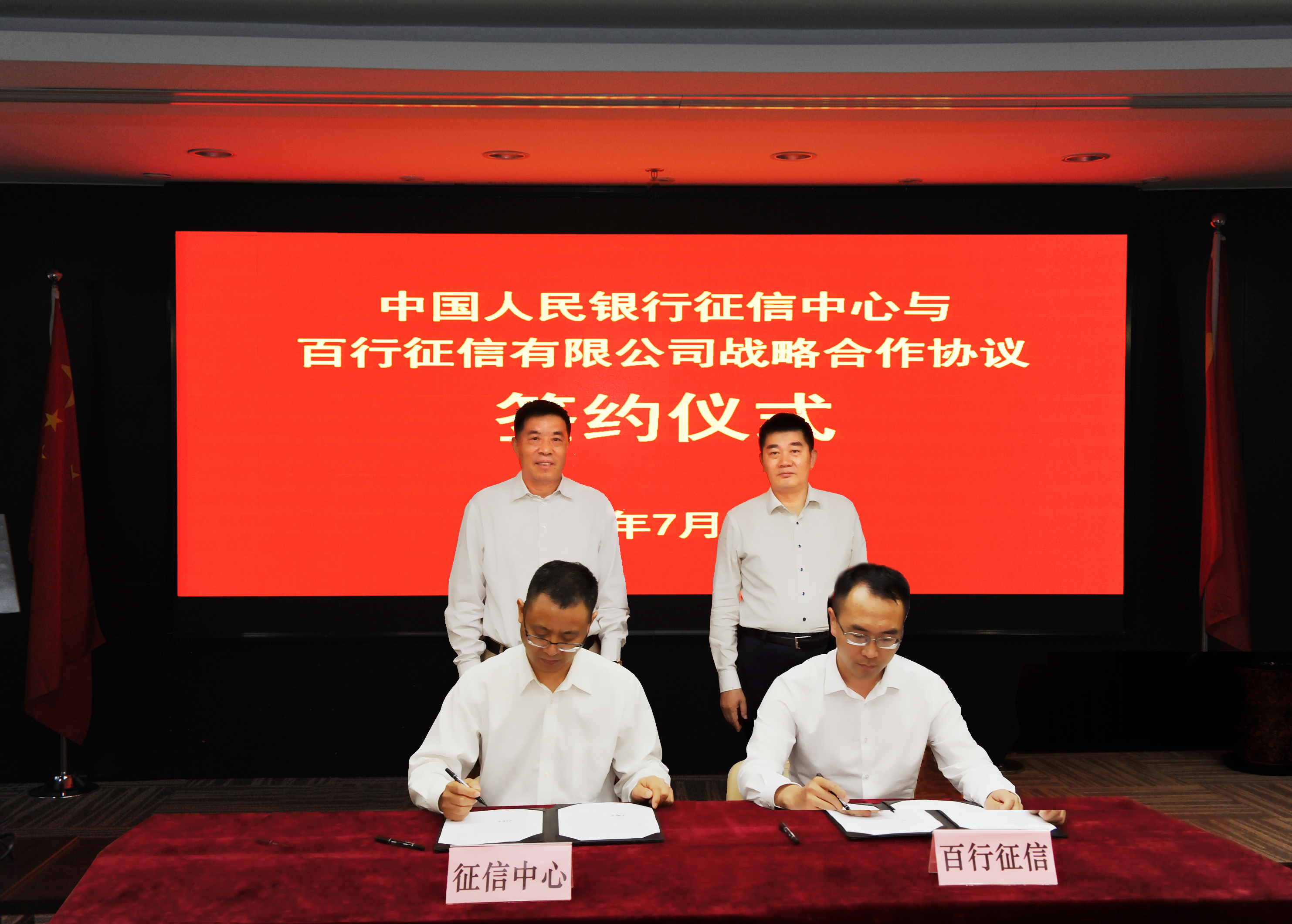
On July 17, 2020, the Credit Reference Center (CRC)of the People’s Bank of China(PBOC) and Baixing Credit Co., Ltd. (Baixing Credit) formally signed a strategic cooperation agreement. Jianhua, Chen Secretary of the Party Committee of CRC, and Huanqi, Zhu Chairman of Baixing Credit, attended the signing ceremony. Zhenzhong, Wang deputy director of CRC, and Pengpeng, Liu vice president of Baixing Credit Information, signed the contract on behalf of both parties.

   According to the agreement, the two institutes will actively carry out credit reporting strategy, business, and technical cooperation research under the premise of compliance with laws and regulations and guaranteeing information security, and effectively play the role of “government + market” to jointly promote the prosperity and development of my country’s credit reporting market. 

In accordance with the design of the PBOC on China’s credit reporting market, the two institutions have achieved differentiated development, adhered to the principles of mutual benefit and gradual progress, and jointly explored innovations in cooperation mechanisms, enhanced the innovation capabilities of both institutes’ credit reporting services, and jointly created and maintained a fair market environment. At the same time, both parties will strictly implement the relevant provisions of the 《Regulations on the Management of Credit Reporting Industry》to effectively protect the rights and interests of information subjects (Especially Consumers).

PCCM Review: It’s a good news. The development of China’s credit reporting industry requires resource integration, cooperation and sharing.

About The Credit Reference Center(CRC), the People’s Bank of China

CRC was established in March 2006 with the approval of the State Commission Office of Public Sectors Reform. As an independent credit information service institution under the People’s Bank of China (PBC), the Center’s mandate is to establish, operate and maintain the national centralized commercial and consumer credit reporting system.

About Baihang Credit

img

Baihang Credit Co., Ltd. is the first company in China that has obtained a consumer credit reporting business license. It is organized by National Internet Finance Association of China and eight market institutes, including Zhima Credit, Tencent Credit, Qianhai Credit, Kaola Credit, Pengyuan Credit, Zhongchengxin Credit, ZhongzhichengCredit Report, and Huadao Credit. The company was incorporated in Shenzhen on March 19, 2018 and settled in Futian, with a registered capital of 1 billion Yuan.

Resource Link