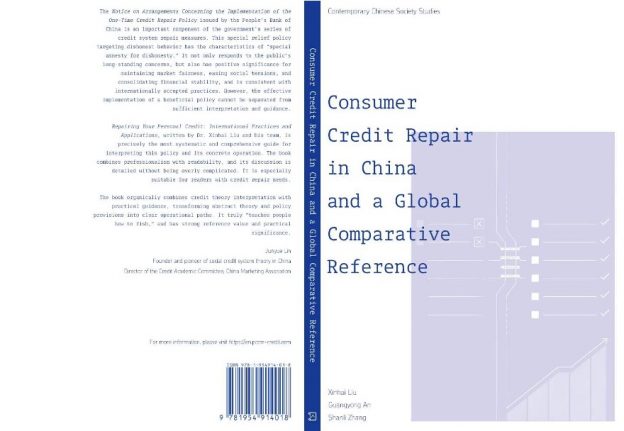
PCCM is pleased to introduce the English edition of Credit Repair in China and a Global Comparative Reference, a pioneering publication examining personal credit repair in China through an international comparative perspective.

To our knowledge, this is the first book from China dedicated to the systematic study of personal credit repair and rehabilitation. While credit repair has long been a well-established topic in the United States—with an extensive market of books, advisory services, consumer organizations and specialized businesses—the subject remains relatively new in China.
The publication builds on years of research by our team into personal credit reporting, consumer protection, credit rehabilitation and the broader personal credit economy. It seeks not only to explain how credit repair works, but also to address a more fundamental question:
How can a modern credit system maintain appropriate credit discipline while giving consumers who have experienced financial difficulties a meaningful opportunity to rebuild their credit?
From Credit Reporting to Credit Rehabilitation
Credit reporting systems are essential infrastructure for modern financial markets. They help lenders assess risk, reduce information asymmetry and support responsible access to credit.
However, an effective credit system must address not only how financial difficulties are recorded, but also what happens afterward.
Consumers may experience repayment difficulties for many reasons, including economic downturns, unemployment, illness, family emergencies or systemic shocks such as the COVID-19 pandemic. Once their financial situation improves and their obligations are resolved, an important policy question arises: how should the credit system recognize recovery?
This is where credit repair and credit rehabilitation become an important part of the personal credit economy.
Our research has also found that this field contains both significant opportunities and serious risks. Alongside legitimate consumer services, financial education and technological innovation, credit repair markets can also give rise to misleading services, abusive practices and illegal “credit washing.” Developing a sound framework therefore requires a careful combination of consumer protection, financial regulation, credit reporting governance and market innovation.
Five Key Dimensions of the Book
The book is organized around five major areas:
1. The historical development of credit reporting and credit systems
The book begins by examining how modern credit reporting developed and why credit information became a fundamental component of consumer finance.
2. Why personal credit repair matters
It examines the economic and social consequences of impaired credit and explores why consumers need legitimate mechanisms to correct errors, resolve past problems and rebuild their financial lives.
3. International comparison
The book reviews credit repair and rehabilitation practices across different jurisdictions, providing a comparative perspective on how credit systems balance risk management, consumer protection and the principle of a second chance.
4. Key institutional mechanisms
It examines mechanisms including credit information disputes and correction, the treatment and retention of negative information, debt resolution and other institutional arrangements that can support credit rehabilitation.
5. Implications for China
Drawing on international experience, the book discusses the development of China’s personal credit rehabilitation framework and the broader evolution of its consumer credit system.
Overall, the publication combines international comparison with institutional analysis, making it relevant not only to researchers but also to financial institutions, credit reporting organizations, regulators, consumer protection professionals and the broader credit industry.
A Timely Publication as China Introduces a New Credit Rehabilitation Policy
The publication is particularly timely.
In response to the lingering economic effects of the COVID-19 pandemic, the People’s Bank of China (PBoC)decided to implement a one-time personal credit rehabilitation policy beginning in 2026.
Under the policy, personal overdue records arising between January 1, 2020 and December 31, 2025, with an individual amount not exceeding RMB 10,000, will no longer be displayed in China’s Financial Credit Information Basic Database if the individual fully repays the overdue debt by March 31, 2026.
The policy also provides consumers with additional opportunities to obtain their personal credit reports free of charge during the first half of 2026.
The initiative represents an important experiment in balancing credit discipline, consumer protection and economic recovery. Rather than simply forgiving debt, it links credit rehabilitation to repayment, providing a targeted pathway for consumers who have resolved relatively small overdue obligations to rebuild their credit standing.
The research behind this book was conducted over several years and contributed intellectual and comparative support to discussions surrounding the development of China’s credit rehabilitation framework.
The book also received a recommendation from a former Director-General of the Credit Information System Bureau of the People’s Bank of China, reflecting the policy relevance of this research.
Credit Repair as Part of the Personal Credit Economy
PCCM views personal credit repair not as an isolated consumer service, but as an important component of the broader personal credit economy.
Around credit reporting systems exists an expanding ecosystem involving credit monitoring, financial education, debt counseling, identity protection, credit-building products, consumer dispute services and personal financial management.
As China’s consumer credit market continues to develop, similar needs are emerging.
The challenge is therefore not simply whether credit repair should exist, but how legitimate credit rehabilitation services can be distinguished from misleading or illegal practices, and how a professional and responsible market can develop around consumers’ genuine needs.
The Next Frontier: AI-Powered Personal Credit Management
Artificial intelligence may significantly change this field.
In the future, AI systems could help consumers understand complex credit reports, identify possible errors or inconsistencies, explain factors affecting their credit standing, navigate legitimate dispute and rehabilitation procedures, and develop personalized strategies for improving their financial health.
For financial institutions and credit service providers, AI may also enable more scalable and personalized approaches to consumer education, credit monitoring and post-distress financial rehabilitation.
This creates opportunities extending beyond traditional “credit repair” toward a much broader field of AI-powered personal credit management and financial health services.
We believe this intersection of credit reporting, consumer protection, personal data and artificial intelligence will become an increasingly important area for research, policy development and commercial innovation.
From China to the Global Credit Community
Although the book focuses significantly on China’s experience, its underlying question is global.
Every mature consumer credit system ultimately faces the same challenge:
How should we distinguish between a consumer who remains a credit risk and one who experienced financial difficulty in the past but has since recovered?
Finding better answers to this question matters for consumers, lenders and the economy as a whole.
Through this publication, PCCM hopes to contribute China’s emerging experience to the international discussion while continuing to learn from credit reporting systems and credit rehabilitation practices around the world.
A good credit system should not only remember the past. It should also be capable of recognizing recovery.

The new books is shared with Ms. Sally Vu,KCI from Vietnam


Mr. Manisha Dissanayake, CRB from Sri Lanka;
