Author: Shanli Zhang

Against the backdrop of the continued development and deepening of China’s social credit system, public concern over issues relating to “credit” has reached an unprecedented level. As of December 30, 2025, a total of 8,485,046 dishonest persons subject to enforcement were publicly listed nationwide.[1] However, a common misconception is to conflate “deadbeat debtors” in the field of judicial enforcement—the legal term being “dishonest persons subject to enforcement”—with ordinary credit problems such as overdue bank payments, leading people to assume that all forms of credit impairment can be addressed through a unified credit restoration mechanism. This conceptual confusion may not only cause individuals or enterprises to “knock on the wrong door and apply the wrong remedy” when seeking relief, but also create fertile ground for gray-market businesses operating under the banner of “credit report repair.”
I. The Institutional Origin and Constitutive Elements of “Deadbeat Debtor” Status: A Sanctioning Status Arising from Judicial Enforcement
Before discussing how such status may be “restored,” it is first necessary to clarify the essential nature of a “deadbeat debtor.” It is neither a simple social label nor the result of a credit score. Rather, it is a sanctioning status arising from a specific judicial enforcement procedure and carrying a clear legal definition. Understanding its distinctive judicial origin is an indispensable foundation for examining all subsequent questions concerning restoration.
(I) Legal Definition and Origin of “Deadbeat Debtor” Status
The widely used expression “deadbeat debtor” is not a legal term. Its formal designation within the legal framework is “dishonest person subject to enforcement.” This system does not originate from the banking credit reporting system or from the broader social credit system. Instead, it derives directly from the Civil Procedure Law of the People’s Republic of China and the Several Provisions of the Supreme People’s Court on the Publication of Information Concerning the List of Dishonest Persons Subject to Enforcement. It constitutes a judicial sanction imposed during compulsory enforcement proceedings by a people’s court in response to specified forms of dishonest conduct.
The central purpose of establishing this system is clear: by using credit-based sanctions as a powerful deterrent and imposing pressure on various aspects of a dishonest person’s life, the system seeks to compel that person to voluntarily perform the obligations determined in an effective legal instrument. It thereby aims to address the long-standing problem of “difficulties in enforcement” that has troubled judicial practice and to firmly safeguard the authority of judicial decisions.
(II) Statutory Circumstances for Inclusion on the Dishonesty List
The legal procedure for determining that a person subject to enforcement is a “deadbeat debtor” and placing that person on the dishonesty list is highly cautious. Two indispensable preconditions must be satisfied simultaneously: first, there must be an effective legal instrument, such as a judgment or ruling; and second, the person subject to enforcement must have committed a specific form of dishonest conduct prescribed by law.
In other words, the mere existence of a debt does not directly result in a person being classified as a “deadbeat debtor.” The key question is whether, during the enforcement stage, the person has engaged in subjectively malicious and dishonest conduct. Article 1 of the Several Provisions of the Supreme People’s Court on the Publication of Information Concerning the List of Dishonest Persons Subject to Enforcement expressly identifies six principal categories of dishonest conduct:
1. Refusing to perform the obligations determined in an effective legal instrument despite having the ability to do so;
2. Obstructing or resisting enforcement by means such as fabricating evidence, violence, or threats;
3. Evading enforcement through sham litigation, sham arbitration, concealment or transfer of assets, or other means;
4. Violating the property reporting system;
5. Violating an order restricting consumption;
6. Refusing, without legitimate reason, to perform an enforcement settlement agreement.
(III) The Critical Distinction Between “Dishonesty” and “Inability to Perform”
To prevent the excessive application of sanctions, judicial policy has long and repeatedly emphasized the need to strictly distinguish “dishonest persons subject to enforcement” from “persons subject to enforcement who genuinely lack the ability to perform,” namely, those who are “incapable of performance.” The latter may have temporarily or permanently lost the ability to perform because of objective circumstances, such as corporate bankruptcy or an individual’s loss of working capacity. Such inability does not automatically constitute “dishonesty” in the legal sense.
This important distinction clearly demonstrates that the target of the dishonest-persons-under-enforcement system is subjectively malicious and objectively dishonest conduct involving “non-performance” or “evasion of performance.” Its institutional logic emphasizes responsibility for conduct rather than punishment for economic failure itself.
Precisely because “deadbeat debtor” status constitutes a judicial sanction, the legal consequences faced by such persons extend far beyond ordinary credit-record issues. A cross-departmental and cross-sectoral network of coordinated sanctions has therefore been established.
II. The Principal Consequences of “Deadbeat Debtor” Status: The Coordinated Sanctions Mechanism
The coordinated sanctions mechanism is the most deterrent component of the system governing dishonest persons subject to enforcement. Based on the principle that “dishonesty in one area results in restrictions everywhere,” the mechanism uses information sharing and coordinated supervision among people’s courts, government departments, financial institutions, industry associations, and other entities to transform an otherwise isolated judicial sanction into a society-wide network of restrictions. This substantially increases the cost of dishonest conduct, minimizes the room available for dishonest persons to operate, and compels them to perform their legal obligations.
(I) Operation of the Coordinated Sanctions Mechanism
The mechanism operates in a straightforward manner. People’s courts at all levels enter information concerning dishonest persons subject to enforcement into the unified database maintained by the Supreme People’s Court and notify “relevant government departments, financial regulatory authorities, financial institutions, public institutions performing administrative functions, industry associations, and other entities.” Upon receiving such information, these entities impose corresponding restrictive measures on the listed persons in accordance with the laws, regulations, and relevant rules governing their respective fields.
(II) Principal Sanctions
Once an individual or enterprise is included on the list of dishonest persons subject to enforcement, it will face a series of severe coordinated sanctions, including but not limited to the following:
- Restrictions on financing and credit: When reviewing loan applications, processing credit card applications, and providing other services, financial institutions may impose strict restrictions or directly refuse to provide the relevant financial services, thereby effectively cutting off access to financing.
- Restrictions on market access and qualification recognition: Dishonest persons subject to enforcement may be strictly restricted or directly excluded from key areas such as government procurement, bidding and tendering, administrative approvals, government support, and qualification recognition.
- Restrictions on high-value consumption and consumption not necessary for daily life or work: This is the sanction most familiar to the public. Prohibited activities include traveling by airplane, occupying soft-sleeper berths on trains, or traveling in second-class or higher cabins on ships; engaging in high-value consumption at star-rated hotels, nightclubs, golf courses, and similar venues; and enrolling one’s children in high-fee private schools.
- Restrictions on holding important positions: Dishonest persons subject to enforcement may be prohibited from serving as directors, supervisors, or senior executives of companies, as well as legal representatives of public institutions, senior executives of financial institutions, and holders of other important positions.
In the face of such severe coordinated sanctions, seeking credit restoration inevitably becomes the preferred course of action for dishonest persons or entities. However, the path to restoration is not unobstructed. It is first necessary to clearly define the boundaries between the judicial system and the various credit restoration systems.
III. Clarifying the Boundaries: Fundamental Differences Between Judicial Sanctions and the Three Categories of Credit Restoration Systems
The greatest public misunderstanding concerning credit restoration lies in the conflation of systems governed by different authorities, based on different regulatory rationales, and operating through different restoration mechanisms.
(I) Overview of China’s “Dual-Track, Three-Pathway” Credit Restoration System
As China’s credit restoration system has developed, it has gradually formed a clear “dual-track, three-pathway” structure. The “dual tracks” refer to financial credit restoration and public credit restoration. The public credit restoration track is further divided into two principal pathways: one coordinated by the National Development and Reform Commission and applicable across society as a whole, and the other led by the State Administration for Market Regulation and focused on business entities.
(II) Comparison of the Core Differences Among the Four Systems
To understand the restoration pathway available to a “deadbeat debtor,” it is first necessary to distinguish the judicial enforcement system from the three principal credit restoration systems. Table 1 provides an in-depth comparison across four core dimensions:
Table 1. Comparison of the Four Systems Related to Credit Restoration
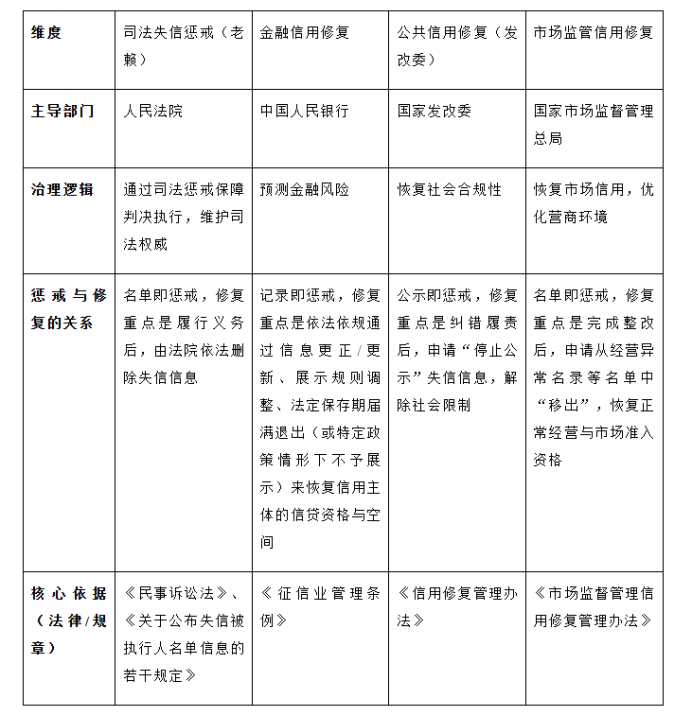
The fundamental differences among these systems in terms of responsible authorities, regulatory rationale, forms of sanctions, and legal basis determine that the credit restoration of a “deadbeat debtor” cannot bypass judicial procedures. Instead, it must follow a specific sequence and pathway.
IV. The Path to Restoration: The Correct Sequence and Coordination Among Multiple Pathways
The credit restoration of a “deadbeat debtor” is a systematic undertaking rather than a single act. It requires the dishonest person or entity to first fulfill its obligations at the judicial level before proceeding in an orderly manner to address issues under the other three credit restoration systems.
(I) The Absolute Prerequisite: “Judicial Delisting” Through Completion of the Judicial Enforcement Procedure
For a “deadbeat debtor,” the sole and absolute starting point for every restoration pathway is to perform the relevant legal obligations and obtain “judicial delisting” from the enforcement court that made the original inclusion decision—that is, the deletion of the relevant information from the list of dishonest persons subject to enforcement. Any attempt at restoration that bypasses the court is institutionally ineffective.
Under Article 10 of the Several Provisions of the Supreme People’s Court on the Publication of Information Concerning the List of Dishonest Persons Subject to Enforcement, the principal statutory circumstances permitting “judicial delisting” include the following:
- Full performance: The person subject to enforcement has performed the obligations determined in the effective legal instrument, or the people’s court has completed enforcement.
- Performance of a settlement agreement: The parties have reached an enforcement settlement agreement, and the agreement has been fully performed.
- Application by the enforcement applicant: The enforcement applicant submits a written request for the deletion of the dishonesty information, and the people’s court approves the request after review.
- No assets available for enforcement: Following termination of the current enforcement procedure, the court has conducted at least two searches for the assets of the person subject to enforcement through the online enforcement inquiry and control system, no assets available for enforcement have been identified, and neither the enforcement applicant nor any other person has provided valid leads concerning assets.
- Change in the enforcement procedure: The people’s court has lawfully ruled to suspend enforcement against the dishonest person subject to enforcement because of trial supervision proceedings or bankruptcy proceedings, or has lawfully ruled not to enforce or to terminate enforcement.
In addition, where a prescribed period of inclusion applies to the relevant dishonest conduct, the people’s court must delete the dishonesty information within three working days after the inclusion period expires.
Once the relevant conditions have been satisfied and the court has deleted the dishonesty information, the corresponding coordinated sanctions, such as restrictions on high-value consumption, will be lifted. This constitutes the legal foundation and “passport” for subsequent engagement with the other credit restoration systems.
(II) Relationship with Financial Credit Restoration: No Substitution, but Institutional Linkage Exists
The financial credit restoration mechanism cannot, as a matter of institutional design, directly affect or replace a person’s dishonest status at the judicial level. A “deadbeat debtor” cannot have the status of dishonest person subject to enforcement removed by applying to the People’s Bank of China or to any financial institution.
Nevertheless, a critical linkage exists between the two systems. People’s courts transmit information from the list of dishonest persons subject to enforcement to the central bank’s credit reporting system, and credit reporting agencies record such information in credit reports in accordance with the law.
An important detail following restoration must not be overlooked. Even after the court has completed “judicial delisting” and lifted the sanctions operating in real time, the relevant adverse records will, under the Regulations on the Administration of the Credit Reporting Industry, remain in an individual’s credit report for five years from the date on which the adverse conduct or event terminates. A clear distinction must therefore be drawn between the “lifting of real-time sanctions” and the “statutory retention of historical credit records.” These are two entirely different concepts.
(III) Relationship with Public Credit Restoration: A Subsequent Follow-On Mechanism
For a “deadbeat debtor,” the public credit restoration system coordinated by the National Development and Reform Commission functions as a subsequent follow-on mechanism rather than an independent starting pathway.
The correct sequence of restoration is as follows:
First, the people’s court must lawfully lift the dishonesty sanctions and complete the “judicial delisting.” Only thereafter may the dishonest person or entity apply, in accordance with the Measures for the Administration of Credit Restoration, to platforms such as the Credit China website for the cessation of publication of serious dishonesty information relating to the judicially determined dishonest conduct.
(IV) Relationship with Market Regulation Credit Restoration: A Parallel Mechanism for Business Entities
This restoration pathway principally applies to enterprises, individually owned businesses, and other business entities that have been classified as “deadbeat debtors.” Its relationship with judicial restoration may be characterized as parallel.
This means that even after an enterprise has completed “delisting” at the judicial level, if it has also been placed by the market regulation authority on the list of abnormal business operations or the list of seriously unlawful and dishonest entities for other reasons—such as failing to submit an annual report on time or being unreachable at its registered address—it must still independently apply to the market regulation authority that made the original inclusion decision for removal from the relevant list in accordance with the Measures for the Administration of Credit Restoration by Market Regulation Authorities. The two processes do not substitute for one another and must be addressed separately.
V. Conclusion and Summary of the Core Points
The essence of “deadbeat debtor” status, or the status of a dishonest person subject to enforcement, is that it constitutes a sanctioning status arising from judicial enforcement proceedings rather than a simple credit-scoring issue. Accordingly, its restoration must follow a specific pathway under which the performance of judicial obligations is the absolute prerequisite. Clarifying the boundary between judicial sanctions and social credit governance is of vital importance to safeguarding judicial authority, ensuring the sound operation of the credit restoration system, and guiding dishonest persons and entities toward the appropriate forms of relief.
For ease of understanding and practical application, the three principal conclusions and reminders of this article are summarized as follows:
1. “Deadbeat debtor” status is a judicial matter, and restoration begins with the court: The creation and termination of the status of a dishonest person subject to enforcement are ultimately determined by the people’s court. This reflects the basic principle of credit governance that “the authority that makes the determination is responsible for the restoration.” Any attempt to bypass the enforcement court and “clean up” the status of a dishonest person subject to enforcement through financial credit restoration or public credit restoration channels lacks a regulatory basis and is bound to fail. The only correct starting point for restoration is to perform the relevant legal obligations and obtain “judicial delisting” from the court.
2. Restoration is an institutional exit mechanism, not the deletion of historical records: Completion of credit restoration means that real-time sanctions, such as restrictions on high-value consumption, are lifted and the publication of the relevant dishonesty information is discontinued, allowing the person or entity to return to normal social and economic activities. It does not mean that every historical trace will be deleted. In particular, relevant adverse records in financial credit reports will remain for five years from the date on which the relevant conduct terminates, as required by law. Dishonest persons and entities should therefore establish appropriate expectations.
3. Credit restoration is legally provided free of charge; beware of “credit report repair” scams: All credit restoration procedures administered by official authorities, including courts, the National Development and Reform Commission, and the State Administration for Market Regulation, are free of charge. Any intermediary service claiming that it can use paid “internal operations” or “technical methods” to remove adverse records prematurely or in violation of applicable rules belongs to the gray market. Such services may not only cause financial losses but may also involve unlawful conduct. Applications should always be submitted lawfully through official channels to avoid fraud.
References
[1]China Enforcement Information Online (zxgk.court.gov.cn): https://zxgk.court.gov.cn/.
Note: The author is Shanli Zhang. He is a doctoral candidate at the School of Law, Shandong University. The original title of the article was “An Analysis of the Formation Mechanism of ‘Deadbeat Debtors’ and Their Normative Relationship with the Credit Restoration System.” WeChat: 18811157736. Comments and corrections are welcome.