Author: Shanli Zhang
As the economy and society continue to develop and the credit system is gradually improved, credit repair has appeared with increasing frequency in policy discussions and public discourse. Public attention has risen significantly, particularly following the recent introduction by the People’s Bank of China of policy arrangements concerning “one-time credit repair.”[1][2] At the same time, however, there have been widespread misunderstandings that conflate “financial credit repair” with “public credit repair.” To address this confusion, this article uses a “two-track, three-pathway” framework to systematically explain the differences between financial credit repair and public credit repair in terms of their governing authorities, applicable parties, and repair mechanisms, thereby helping the public avoid conceptual confusion when interpreting and using these policies.
I. Background
China began gradually establishing its social credit system in the early 2000s and has continued to improve it alongside economic and social development. On this basis, credit repair has progressively developed into a “two-track, three-pathway” framework: financial credit repair led by the People’s Bank of China, together with the National Development and Reform Commission pathway and the market regulation pathway within public credit repair. This framework is shown in Figure 1:
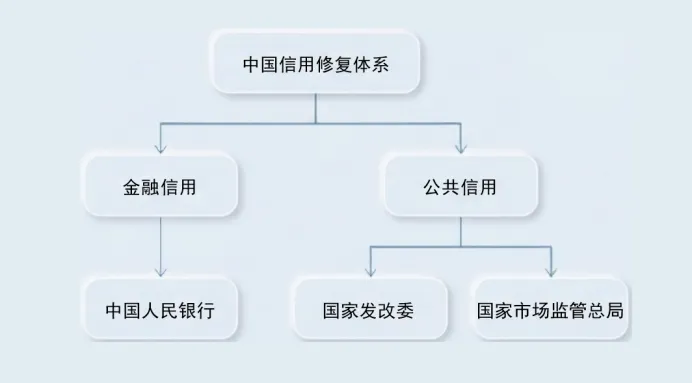
Figure 1 Categories of Credit Repair in China
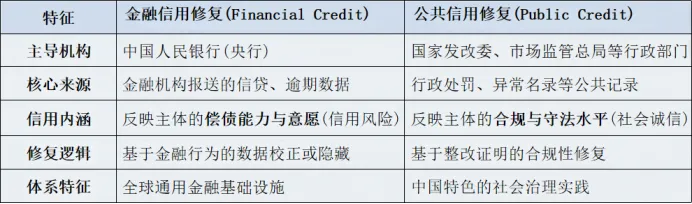
As shown in Table 1, financial credit repair is primarily led by the People’s Bank of China and constitutes an important component of China’s financial infrastructure, consistent with internationally accepted principles of credit-reporting governance. It focuses on correcting financial-behavior data concerning individuals and enterprises, such as records of overdue loans and credit-card payments. It generally affects access to financial services and restores financial credit through information correction or updating, adjustments to display rules, or removal upon expiration in accordance with laws and regulations. Public credit repair, by contrast, is led by authorities including the National Development and Reform Commission and the State Administration for Market Regulation. It focuses on social governance and compliance constraints and generally restores an entity’s social credit by ending the public disclosure of relevant information and lifting restrictions after the entity has corrected its misconduct and fulfilled its obligations. Both systems emphasize providing an “opportunity to correct mistakes,” but they differ in their scope of application and the boundaries of their respective mechanisms.
Table 1 The “Dual-Track System”: The Same Term with Different Meanings
II. The Background, Development, and Authoritative Policy Positions of the Three Major Credit Repair Systems
China’s credit repair system is administered by multiple government departments and primarily comprises the financial credit system, the public credit system led by the National Development and Reform Commission, and the market regulation system led by the State Administration for Market Regulation. Although all three systems involve credit repair, they differ in their backgrounds, development paths, and authoritative policy positions.
(I) Financial Credit Repair by the People’s Bank of China: From “Absolute Recordkeeping” to “Policy-Based Relief”
1. Background and Origins, 1999–2013
China’s financial credit-reporting system began relatively early. A credit-reporting administration was established as early as 1999, primarily to address information asymmetry in financial markets and assist financial institutions in assessing borrowers’ credit risks. During this period, the credit-reporting system was centered on “faithful recordkeeping,” requiring financial institutions to record the credit histories of individuals and enterprises fully and accurately in order to prevent financial risks. The concept of credit repair had not yet been clearly defined, and the system focused solely on the objective recording and management of credit information.
2. Development Path, 2013–2024
The promulgation of the Regulation on the Administration of the Credit Reporting Industry in 2013 marked a new stage in the development of China’s financial credit system. The Regulation provides that adverse personal information must be retained for five years from the date on which the relevant adverse conduct or event ends and must be deleted in accordance with the law after the five-year period expires.[3] This is not equivalent to the “arbitrary deletion of records”; rather, it is a rules-based removal process following the expiration of a statutory retention period. Within this framework, “active repair” in the traditional sense is reflected primarily in mechanisms such as information correction, dispute resolution, and adjustments to display rules.
3. Authoritative Policy Position, 2025
On October 27, 2025, Pan Gongsheng, Governor of the People’s Bank of China, announced that the central bank would implement a “one-time personal credit relief policy” in early 2026.[4] The policy is primarily directed at borrowers who defaulted on small consumer loans because of the pandemic or other force majeure events but have since fulfilled their repayment obligations. The relevant default information of eligible borrowers will be subject to policy-based adjustment in the credit-reporting system in accordance with applicable rules. On December 22, 2025, the People’s Bank of China issued the Notice on Arrangements for Implementing the One-Time Credit Repair Policy, further clarifying the applicable conditions and operational arrangements. It should be emphasized that the policy provides for eligible overdue information to be “excluded from display in accordance with applicable rules,” rather than permitting “paid deletion” or “whitewashing.” It is also a policy-based relief arrangement that eligible individuals may enjoy automatically without submitting an application.
(II) Public Credit Repair by the National Development and Reform Commission: From “Across-the-Board Sanctions” to “Tiered and Classified Restructuring”
1. Background and Origins, 2014–2018
With the issuance of the Planning Outline for the Development of the Social Credit System (2014–2020) in 2014, China began constructing a credit system covering the whole of society.[5] During this period, the Chinese government focused on promoting social integrity and establishing a cross-departmental joint disciplinary mechanism against untrustworthy conduct that covered the whole of society. By publicly disclosing information about untrustworthy conduct, restricting certain rights and interests of untrustworthy entities, and implementing disciplinary measures, the government sought disciplinary measures, the government sought to compel such entities to comply with laws and regulations and fulfill their social responsibilities.
Public credit repair was not clearly defined at the outset. Instead, the emphasis was placed on sanctioning and recording untrustworthy conduct. Once such conduct was confirmed, it would be recorded and publicly disclosed on the Credit China website. Repair mechanisms during this stage were relatively preliminary and relied mainly on untrustworthy entities applying for removal from a “blacklist” after proactively correcting their misconduct.
2. Development Path, 2019–2024
After 2019, as the social credit system was further improved, the National Development and Reform Commission began gradually adjusting the measures used to sanction untrustworthy conduct and introduced more flexible credit repair models. In particular, a repair model under which an application could be made once the misconduct had been corrected began to be implemented. This model allowed untrustworthy entities, after proactively correcting their conduct and fulfilling their statutory obligations, to apply to the relevant authorities to end the public disclosure of the relevant information and lift associated restrictions.
3. Authoritative Policy Position, 2025
On November 20, 2025, the National Development and Reform Commission issued the Measures for the Administration of Credit Repair, which will formally take effect on April 1, 2026.[6] The Measures provide more systematic and detailed rules for public credit repair, clearly specifying the repair standards and time limits applicable to different records of untrustworthy conduct. They also introduce, for the first time, a “tiered and classified” management model for information concerning untrustworthy conduct, under which different repair periods are established according to the seriousness of the misconduct. The introduction of this policy not only improves the precision of public credit repair administration but also provides untrustworthy entities with fairer opportunities.
(III) Credit Repair by the State Administration for Market Regulation: An Important Component of the Public Credit System
1. Background and Origins, 2014–2021
The credit repair policies of the State Administration for Market Regulation constitute an important part of the public credit system and are specifically directed at market entities. In the early stages, market regulators supervised enterprises through instruments such as the List of Enterprises with Abnormal Operations and the List of Seriously Untrustworthy and Unlawful Entities. The aim was to increase overall public awareness of creditworthiness and compliance with the law through transparent information disclosure and disciplinary mechanisms.
2. Development Path, 2021–2024
In 2021, the State Administration for Market Regulation issued the Measures for the Administration of Credit Repair in Market Regulation, marking the institutionalization and standardization of credit repair mechanisms in the field of market regulation.[7] The Measures provided enterprises with clear pathways for credit repair, including applications for removal from the List of Enterprises with Abnormal Operations and the termination of untrustworthiness-related management measures. At the same time, the State Administration for Market Regulation accelerated the development of a “national unified platform” and promoted the “one-stop credit repair service” reform, simplifying repair procedures and improving the efficiency with which enterprises could restore their credit.
3. Authoritative Policy Position, 2025
On December 25, 2025, the State Administration for Market Regulation will implement the latest revised version of the Measures for the Administration of Credit Repair in Market Regulation. The revision further expands the scope of credit repair and establishes temporary credit repair arrangements for “enterprises undergoing reorganization or settlement.” During the implementation of a reorganization plan or settlement agreement, an enterprise may apply for temporary credit repair by submitting the relevant ruling or other legal documents issued by a people’s court. The relevant information concerning untrustworthy conduct may then be temporarily concealed, and management measures that could affect the implementation of the reorganization or settlement may be lifted.[8] This measure helps reduce the prolonged effects of credit sanctions, supports enterprises in resuming operations and participating in market competition, and is consistent with the policy objective of improving the business environment.
III. A Comprehensive Comparison: The Logic and Core Differences Among the Three Major Credit Repair Pathways
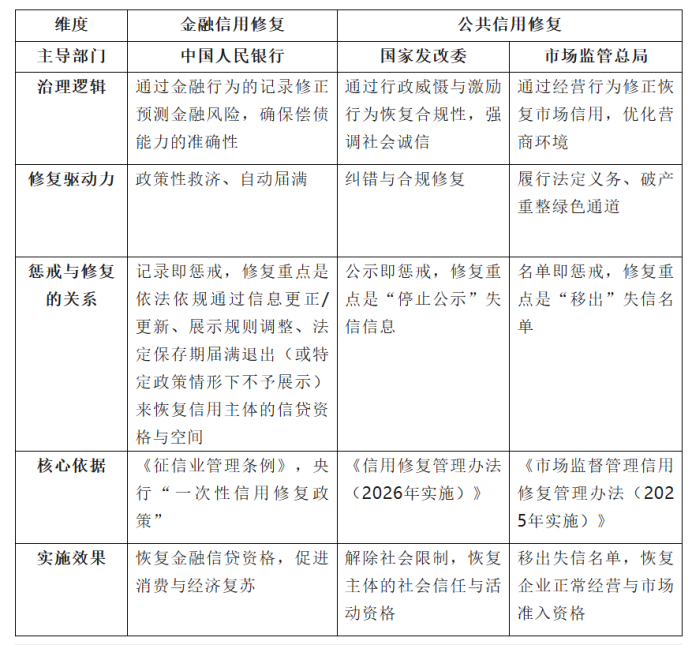
As shown in Table 2, although China’s two categories of credit repair—financial credit repair and public credit repair—both serve the objective of restoring the credit of entities that have engaged in untrustworthy conduct, they differ in their underlying logic, scope of application, repair pathways, and implementation mechanisms. Financial credit repair is concentrated primarily in the financial sector and mainly concerns the correction of financial data. Public credit repair led by the National Development and Reform Commission focuses on social compliance and primarily addresses the correction of untrustworthy conduct. Credit repair under market regulation, led by the State Administration for Market Regulation, focuses on the compliance of enterprise conduct, particularly the restoration of enterprises’ operating qualifications and market credit in the commercial sphere.
Table 2 A Comprehensive Comparison of the Two Categories of Credit Repair
(I) Financial Credit Repair
Financial credit repair led by the People’s Bank of China follows the principle that “recording itself constitutes a sanction.” Financial institutions record customers’ defaults in credit reports, while the core of repair lies in restoring the credit eligibility and borrowing capacity of the relevant individuals or entities through information correction or updating, adjustments to display rules, or removal upon expiration in accordance with laws and regulations, rather than arbitrarily “deleting history.”
Financial credit repair is driven primarily by two factors. The first is policy-based relief under particular circumstances, such as relief arrangements introduced in response to the pandemic or other force majeure events, under which information relating to eligible defaulters may be subject to adjustments in its display in accordance with applicable rules. The second is automatic removal following the expiration of the statutory retention period, meaning that adverse financial records are removed from credit reports in accordance with the law after five years.
Financial credit repair applies to credit records submitted by financial institutions and commonly concerns defaults involving small consumer loans, outstanding credit-card balances, and similar obligations. The principal purpose of repair measures is to restore the financial credit of individuals and enterprises in accordance with laws and regulations, enabling them to regain access to loans, credit cards, and other financial services.
(II) Public Credit Repair
1. Public Credit Repair Led by the National Development and Reform Commission
Public credit repair covers the field of social credit, including information concerning the social conduct of individuals and enterprises, administrative penalties, and related matters. Unlike financial credit repair, which focuses on credit-reporting data, public credit repair places greater emphasis on social compliance and lawful conduct and seeks to restore an entity’s social credit status after it has corrected its misconduct and fulfilled its obligations.
The governance logic of public credit repair is that “public disclosure itself constitutes a sanction.” Once the conduct of an untrustworthy entity is recorded and publicly disclosed, the entity becomes subject to social and regulatory constraints. After correcting its misconduct and fulfilling its statutory obligations, the entity may apply, in accordance with applicable rules, to end the public disclosure, lift the restrictions, and restore its eligibility to engage in the relevant activities.
2. Credit Repair under Market Regulation Led by the State Administration for Market Regulation
Credit repair under market regulation is an important component of the public credit repair system and focuses on credit repair at the enterprise level. Led by the State Administration for Market Regulation, this pathway principally operates through regulatory lists such as the List of Enterprises with Abnormal Operations and the List of Seriously Untrustworthy and Unlawful Entities. It uses credit repair mechanisms to help enterprises restore their market-access qualifications and credit status.
Credit repair under market regulation follows the principle that “listing itself constitutes a sanction.” Once an enterprise is included on a list of abnormal operations or serious untrustworthiness, it becomes subject to restrictions arising from the relevant regulatory measures. The core of the repair process is the enterprise’s removal from the relevant list in accordance with laws and regulations after it has fulfilled its statutory obligations or completed the required corrective measures, thereby restoring its qualification to conduct normal business activities in the market.
The drivers of credit repair under market regulation include the fulfillment of statutory obligations: after correcting unlawful conduct and completing the required rectification, an enterprise may apply for removal from the relevant list. In addition, mechanisms such as a “green channel” for bankruptcy reorganization may provide more convenient credit repair arrangements for particular types of enterprises, thereby reducing the prolonged effects of credit sanctions.
IV. Challenges and Public Misunderstandings Concerning Credit Repair
Although the advancement of credit repair policies has positive implications for strengthening social integrity and economic vitality, public misunderstandings remain a challenge in their practical implementation. Many people confuse financial credit repair with public credit repair and mistakenly believe that all types of records concerning untrustworthy conduct can be eliminated by applying for their “deletion” or “whitewashing.” In reality, the two differ in both their scope of application and the actions taken to achieve repair. Financial credit repair focuses on the correction of credit-reporting information and adjustments to display rules, whereas public credit repair focuses on ending public disclosure and lifting restrictions after misconduct has been corrected. Such misunderstandings may also foster a gray industry operating under the name of “credit-report repair,” in which unscrupulous organizations charge substantial fees while promising to “erase records.” Such promises are generally incapable of being lawfully fulfilled and may instead result in fraud and legal disputes, thereby disrupting the proper operation of the credit repair system.
In addition, financial credit repair and public credit repair are led by different government authorities, including the People’s Bank of China, the National Development and Reform Commission, and the State Administration for Market Regulation. Because the boundaries between the systems and their points of access are not sufficiently intuitive, members of the public may repeatedly seek advice or submit applications to different departments. Differences in the standards or explanations applied by those departments may even lead to procedural mismatches, increasing both time and administrative costs and reducing the efficiency of policy implementation.
The government therefore needs to further improve clarity in both information disclosure and policy implementation, ensuring that the public can properly understand and use these policies. Particular emphasis should be placed on explaining “what can be repaired, which authority should be contacted, and how the process works.” The applicable scope, application channels, required materials, and time limits for different types of repair should be clearly specified, while cross-departmental information sharing and procedural integration should be advanced. At the same time, continuing public education and risk warnings are needed to reduce misunderstanding and misuse.
Finally, if the definition and scope of credit repair are not clearly delineated, the financial credit system may be adversely affected, particularly through the weakening of the risk-warning function of “faithful recordkeeping.” One of the major objectives of financial credit reporting is to prevent financial risks and protect financial institutions from excessive risk exposure. If repair is excessive or abused, the credibility of the credit-reporting system will be undermined, potentially affecting the stability of financial markets. Maintaining the rigor and transparency of repair mechanisms and ensuring that they apply only to eligible individuals and entities in accordance with laws and regulations are therefore essential to the proper functioning of the credit system.
Overall, credit repair policies must maintain a careful balance in their implementation. They should provide sufficient repair opportunities to help entities that have engaged in untrustworthy conduct reintegrate into society, while also preventing abuse and improper practices and ensuring that repair procedures remain fair and transparent.
V. Conclusion
The “dual-track, three-pathway” credit repair system led by the People’s Bank of China, the National Development and Reform Commission, and the State Administration for Market Regulation applies to different parties and operates through different mechanisms. Financial credit repair focuses primarily on the presentation and updating of credit-reporting information. Public credit repair focuses on ending public disclosure and lifting restrictions after misconduct has been corrected. Credit repair under market regulation focuses on removal from regulatory lists and the restoration of market access. Together, these three repair pathways reflect an equal emphasis on sanctions and rehabilitation: while maintaining necessary constraints, they provide a route back for entities that have corrected their misconduct and fulfilled their obligations, thereby improving governance effectiveness and public trust.
Looking ahead, the further improvement of credit repair mechanisms requires clearer institutional distinctions among the different types of repair pathways in order to prevent confusion. Cross-departmental coordination should also be strengthened, information sharing and procedural integration should be promoted, and the efficiency of repair should be improved. Public education and risk warnings should be treated as long-term priorities to reduce misunderstanding and abuse. The objective of credit repair is to ensure that, after correcting their misconduct and fulfilling their obligations, entities that have engaged in untrustworthy conduct can restore their credit through legitimate channels and continue participating in social and economic activities, maintaining a balance between “compassion and order.”
References
[1] People’s Bank of China, “Notice of the People’s Bank of China on Arrangements for Implementing the One-Time Credit Repair Policy” [EB/OL], December 22, 2025, available at https://www.pbc.gov.cn/goutongjiaoliu/113456/113469/2025122116371667030/index.html (last accessed December 24, 2025).
[2] People’s Bank of China, “Questions and Answers with the Press Concerning the Notice of the People’s Bank of China on Arrangements for Implementing the One-Time Credit Repair Policy” [EB/OL], December 22, 2025, available at https://www.pbc.gov.cn/goutongjiaoliu/113456/113469/2025122116421625696/index.html (last accessed December 24, 2025).
[3] State Council, Regulation on the Administration of the Credit Reporting Industry, State Council Order No. 631, promulgated January 21, 2013, effective March 15, 2013, Article 16.
[4] Xinhua News Agency, “The People’s Bank of China Is Studying the Implementation of a One-Time Personal Credit Relief Policy” [EB/OL], October 27, 2025, available at http://www.news.cn/fortune/20251027/39190dbb704141a197ad9e8e7213b754/c.html (last accessed December 24, 2025).
[5] State Council, “Notice of the State Council on Issuing the Planning Outline for the Development of the Social Credit System (2014–2020),” State Council Document No. 21 [2014], June 14, 2014 [EB/OL], available at https://www.gov.cn/gongbao/content/2014/content_2711418.htm (last accessed December 24, 2025).
[6] National Development and Reform Commission, Measures for the Administration of Credit Repair [EB/OL] (PDF), available at https://www.ndrc.gov.cn/xxgk/zcfb/fzggwl/202511/P020251126424276238205.pdf. The document states, among other matters, that “these Measures shall take effect on April 1, 2026, and the Measures for the Administration of Credit Information Repair Following the Correction of Untrustworthy Conduct (Trial) shall be repealed” (last accessed December 24, 2025).
[7] State Administration for Market Regulation, “Notice of the State Administration for Market Regulation on Issuing the Measures for the Administration of Credit Repair in Market Regulation,” SAMR Credit Regulation Document No. 3 [2021], issued July 30, 2021, effective September 1, 2021 [EB/OL], available at https://www.gov.cn/zhengce/zhengceku/2021-08/04/content_5629304.htm (last accessed December 24, 2025).
[8] State Administration for Market Regulation, Measures for the Administration of Credit Repair in Market Regulation, State Administration for Market Regulation Order No. 107, promulgated November 21, 2025, effective December 25, 2025 [EB/OL], available at https://www.samr.gov.cn/zw/zfxxgk/fdzdgknr/fgs/art/2025/art_02b9d3e6f31a4cc38079901ab49994d5.html (last accessed December 24, 2025).
Note: The author is Shanli Zhang. He is a doctoral student at Shandong University. The original title of this article was “A Comprehensive Analysis of China’s Credit Repair System: The ‘Dual-Track’ Model of Financial Credit and Public Credit.” ItDual-Track’ Model of Financial Credit and Public Credit.” It is the full-text version of a roundtable presentation delivered at the “Eighth Credit Rule of Law · Shaoshan Luntang Forum,” held at Xiangtan University on December 21, 2025. WeChat: 18811157736. Comments and corrections are welcome.