Author: Shanli Zhang
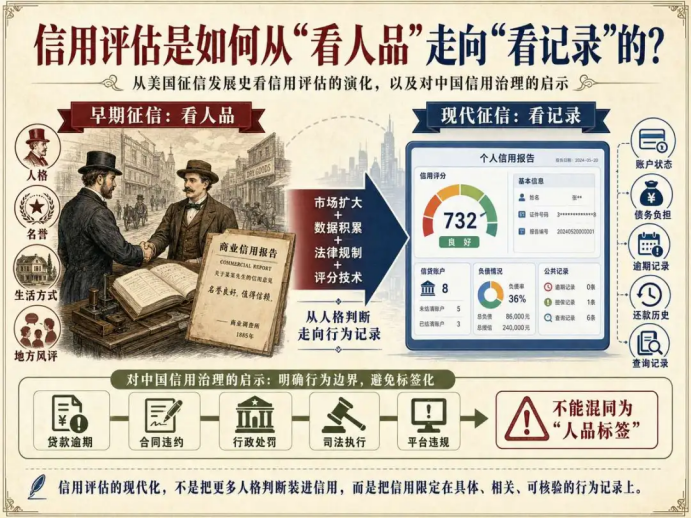
When a person falls behind on a loan payment, it will naturally affect their next loan application. But matters become more complicated when loan delinquencies, contractual breaches, administrative penalties, judicial enforcement actions, and platform rule violations are all placed within a single framework of “credit.” Although these records may all appear to be related to “credit,” they are fundamentally different in nature. Loan delinquency is primarily a matter of financial risk; contractual breach is primarily a matter of civil liability; an administrative penalty is primarily a matter of violating administrative law; judicial enforcement primarily concerns compliance with legally binding instruments; and platform violations primarily concern the governance of platform rules. All of these may constitute negative records, but the fact that they are negative does not mean they should all be interpreted as evidence that “this person is untrustworthy,” still less as proof that “this person has bad character.”
This is precisely the issue that China must guard against as its credit economy develops: once the concept of credit becomes overly expansive, specific records of conduct from different fields can easily be blended into a vague label attached to a person’s character.
The history of credit reporting in the United States provides a useful point of reference. Early American credit reporting also relied on character, reputation, lifestyle, and local opinion. Put simply, creditworthiness was judged by assessing a person’s “character.” Later, however, as the market expanded, credit-reporting data accumulated, legal regulation improved, and scoring technologies developed, mainstream financial credit reporting gradually shifted toward standardized records such as account status, debt burden, delinquencies, and repayment history.
In other words, the modernization of credit assessment does not mean incorporating more character judgments into credit. It means limiting credit assessment to records of conduct that are more specific, more verifiable, and more closely related to risk.
I. Early Credit Reporting: “Character Judgments” in a Market of Strangers
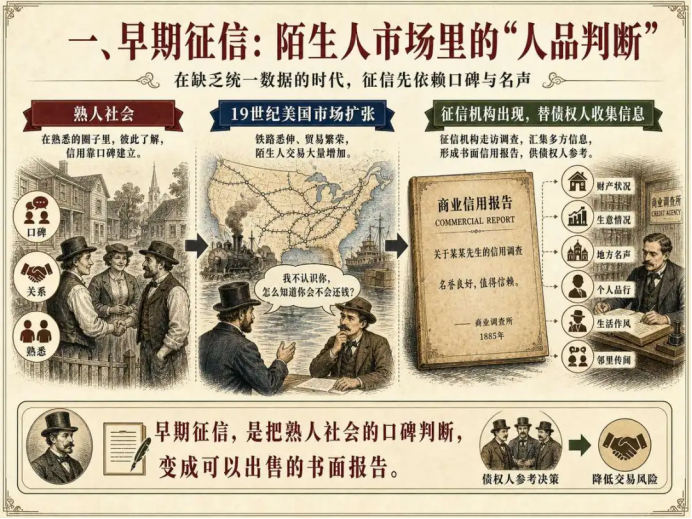
In a society of acquaintances, determining whether someone can be trusted with a loan often requires no complex data. You know where the person lives, what they normally do, what kind of reputation they have, and whether they have ever failed to repay a debt. Among acquaintances, credit depends on reputation and personal relationships.
In the nineteenth century, however, the American market expanded rapidly, and transactions were no longer confined to local circles of acquaintances. Merchants might conduct business with people far away, while creditors increasingly dealt with strangers. A new question therefore arose: if I do not know you, how can I tell whether you will repay your debt?
Today, we can examine accounts, transaction records, debt levels, and histories of delinquency. In early America, however, such standardized data systems had not yet been established. Credit-reporting agencies therefore began collecting information about borrowers on behalf of creditors, including their property, business conditions, local reputation, personal character, lifestyle, and even neighborhood gossip.[1]
In other words, early credit reporting transformed the reputation-based judgments of an acquaintance society into written reports that could be sold to distant creditors.
II. Why Did Early Credit Assessment Become a Matter of “Judging Character”?
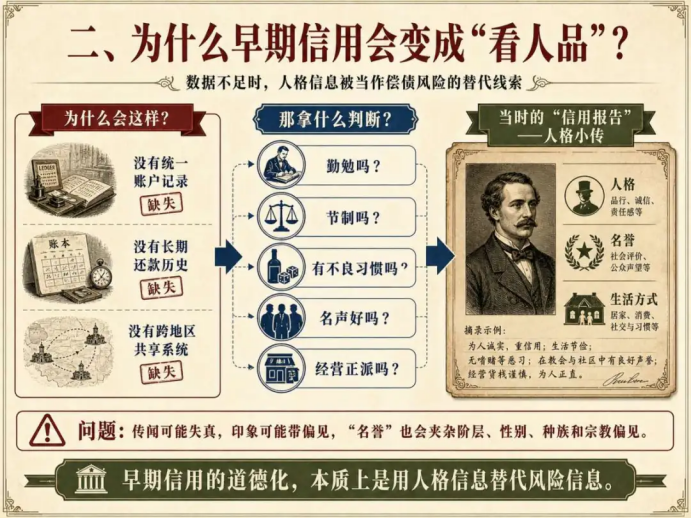
Early credit reporting became moralized not because credit reporting inherently required an assessment of morality, but because reliable data were unavailable at the time.
There were no unified account records, no long-term repayment histories, and no information systems capable of sharing data across regions. Creditors could therefore ask only rougher questions: Is this person diligent? Do they exercise restraint? Do they have undesirable habits? Do they have a good local reputation? Do they conduct business honestly?
Today, these questions may appear to be assessments of character, but at the time they were believed to be related to repayment risk. People assumed that someone who lacked restraint, stability, or diligence would also be more likely to fail to repay a debt on time.
Early credit reports were therefore unlike modern credit reports, which consist primarily of accounts and figures. They were more like brief biographies of a person’s character. Rather than merely recording whether someone had ever been delinquent, they sought to determine whether that person was fundamentally worthy of trust.
This was the moralization of early credit: credit was not merely about debt, but about the person as a whole.
The problem lay precisely here. Local rumors could be inaccurate, personal impressions could be biased, and so-called “reputation” could be shaped by social prejudices involving class, gender, race, religion, and other factors. Once such evaluations were entered into credit reports, they could be packaged as “credit facts” and affect a person’s opportunities in the marketplace.[2]
III. Modern Financial Credit Reporting: From “Evaluating the Person” to “Recording Conduct”
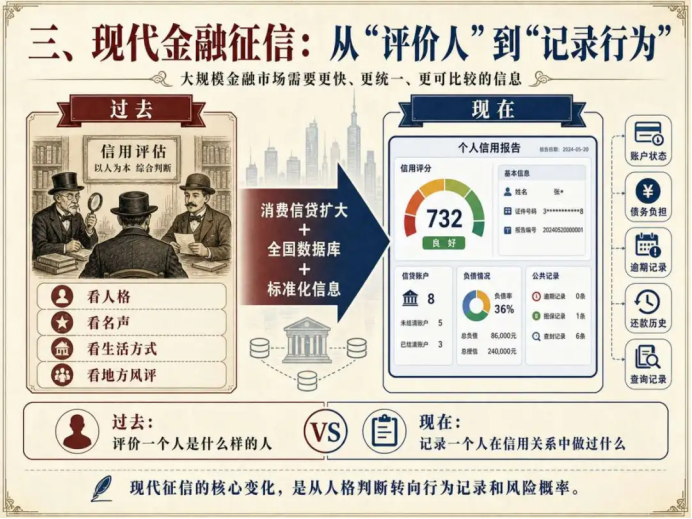
As consumer credit became increasingly widespread in the United States and financial markets continued to expand, local reputation and hearsay could no longer support credit decisions on a nationwide scale.
Banks, retailers, and financial companies needed information that was faster, more standardized, and easier to compare. The credit-reporting system therefore gradually evolved from small local agencies into nationwide databases, and the focus of credit assessment began to change.[3]
The question used to be: Does this person have good character?
The question later became: Has this person made repayments on time?
Previously, the relevant factors were reputation, lifestyle, and local opinion.
Later, the focus shifted to account status, debt burden, delinquencies, repayment history, and records of credit inquiries.
This was the “de-moralization” of mainstream financial credit reporting. It should be noted, however, that de-moralization does not mean that credit is entirely neutral, nor does it mean that credit systems no longer evaluate people. It simply means that mainstream financial credit reporting no longer directly assesses whether someone is a “good person.” Instead, it records whether the person has fulfilled their obligations within financial relationships.
Modern credit reporting has not ceased to evaluate people; it has simply adopted a different method of evaluation. Rather than using the language of character, it evaluates people through records of conduct and probabilities of risk.
IV. How Did Law and Technology Change Credit Assessment?
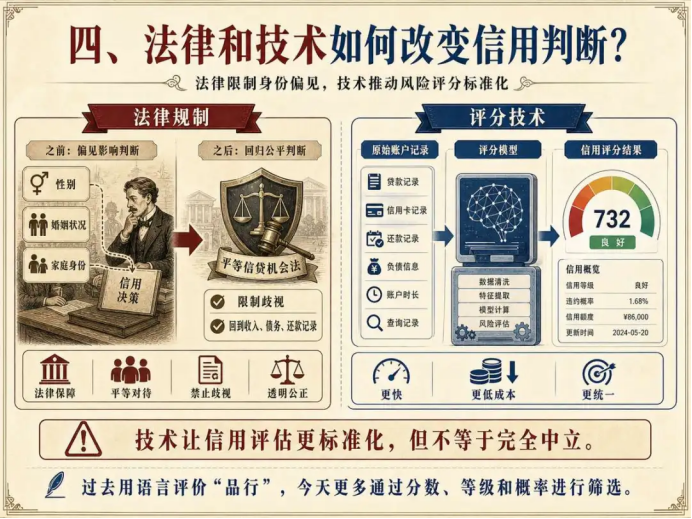
The transformation of American credit reporting resulted not only from market development, but also from legal regulation and technological progress.
On the one hand, the law began to restrict the use of certain identity-related factors in credit decisions. In the past, for example, women applying for credit could face restrictions because of their marital status or family role. Later, the Equal Credit Opportunity Act and related rules restricted credit discrimination based on factors such as sex and marital status. This helped redirect credit assessment toward information genuinely related to the risk of nonperformance, such as income, debt, and repayment history.[4]
On the other hand, credit-scoring technologies emerged. Credit scoring compresses complex account records into a single score or risk category, enabling financial institutions to assess risk more quickly, consistently, and at lower cost.[5]
This further accelerated the shift from narratives about character to calculations of risk.
Technology, however, is not inherently fair. In the past, a credit report might have stated that “this person is of poor character.” Today, a system may simply assign the person a low score. The language and format have changed, but the function of screening remains.
V. Credit Did Not Disappear; It Was “Diverted into Different Channels”
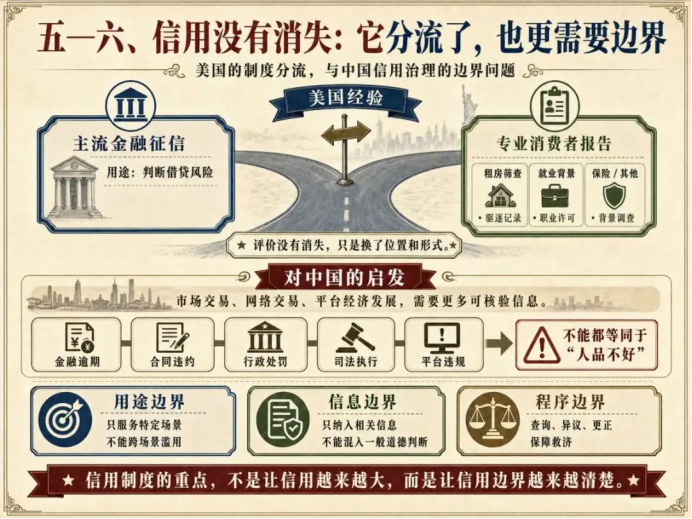
One of the most common misunderstandings about the modernization of American credit reporting is the belief that it has completely eliminated moral judgment. In fact, it has not.
Mainstream financial credit reporting has increasingly centered on records of contractual performance. Yet in areas such as housing, employment, insurance, and background checks, consumer reports may still contain extensive information used to determine a person’s eligibility.[6]
When renting a home, for example, a landlord may review a tenant-screening report. The report may contain credit history, rent-payment records, eviction records, and civil or criminal records. The problem is that an eviction record does not necessarily mean that a tenant deliberately breached an agreement. It may have resulted from a dispute, settlement, dismissal of the case, or even an incomplete record. Once it enters a screening system, however, it may be reduced to the conclusion that “this person presents a risk.”
The same applies to employment. Employers may examine criminal records, educational backgrounds, professional licenses, and employment histories. Certain criminal records may genuinely be relevant to the risks associated with particular positions. But if an employer fails to distinguish between the nature of the offense, how long ago it occurred, and its relevance to the position, and instead excludes anyone with any record, a single event from the past can become a long-term label.
American credit reporting therefore did not move from moralization to complete de-moralization. Instead, an institutional division occurred. On one side is mainstream financial credit reporting, which primarily assesses lending risk. On the other side are specialized consumer reports, which continue to perform eligibility-screening functions in housing, employment, insurance, and other contexts.
Evaluation has not disappeared. It has merely changed its location, form, and language.
VI. Implications for China: The Development of the Credit Economy Must Have Boundaries
As the market economy, online transactions, and the platform economy develop, the scope of transactions continues to expand, and many transactions no longer take place among acquaintances. Businesses, platforms, financial institutions, consumers, and government departments all require more verifiable information to reduce transaction costs, identify the risk of nonperformance, and improve regulatory efficiency. The 2025 Opinions on Improving the Social Credit System, issued by the General Office of the Communist Party of China Central Committee and the General Office of the State Council, also explicitly states that the social credit system is a foundational institution of the market economy. It calls for the establishment of a social credit system that covers all types of entities, operates under unified institutional rules, and is jointly developed, shared, and utilized, while supporting the unified national market and high-quality development.[7]
The construction of a credit system therefore has a legitimate rationale. Financial credit reporting can help banks assess borrowers’ risks; corporate credit information can help counterparties understand the condition of a business; and the disclosure of administrative penalties and judicial enforcement information can improve regulatory transparency and encourage compliance with legal obligations.
The problem, however, is that the construction of a credit system must not turn “credit” into an excessively broad concept.
Records of different kinds may be used, but they must not be used as though they were equivalent. Financial delinquencies, contractual breaches, administrative penalties, judicial enforcement actions, and platform violations correspond to different risks, responsibilities, and governance contexts. They cannot all be simplistically interpreted as evidence that “this person is untrustworthy.”
This is precisely the lesson offered by the history of American credit reporting: the direction of modern credit assessment is not to incorporate more judgments about character, but to confine credit to records of conduct that are specific, relevant, and verifiable.
The development of China’s credit economy should therefore observe at least three boundaries.
First, the boundary of purpose. Credit information should serve specific contexts and should not be used arbitrarily across different contexts. Financial credit reporting should be used to assess lending risk; information about administrative penalties should be used for administrative supervision; judicial enforcement information should be used to promote compliance with legally binding instruments; and records of platform violations should be used to maintain order on the platform.
Second, the boundary of information. Information included in credit assessments should be related to the specific risk concerned. Lifestyle, identity characteristics, and general moral conduct should not be incorporated into credit judgments.
Third, the boundary of procedure. Whenever credit information may affect lending, housing, employment, business operations, or public services, individuals and entities should be guaranteed the rights to access the information, raise objections, request corrections, and seek remedies.
In a word, the central task in developing a credit economy is not to incorporate every negative record into the concept of credit, but to distinguish between records of specific conduct and judgments about a person’s overall character.
Conclusion: Credit Is Not Better When It Is Broader, but When It Is Clearer
The history of American credit reporting shows that credit institutions originally contained a strong element of character assessment. Later, mainstream financial credit reporting gradually shifted from “judging character” to “examining records of performance,” and from character judgments to risk assessment.
This does not mean, however, that credit assessment has become entirely neutral, nor does it mean that moral judgments have completely disappeared. Modern credit increasingly affects people’s opportunities through records, scores, models, and reports.
What truly matters, therefore, is not making credit omnipresent, but ensuring that it is used where it properly belongs.
Credit can help markets reduce risk, but it must not become an all-purpose tool for judging people.
Credit can record specific acts of performance or nonperformance, but it must not be casually elevated into a judgment about character.
Credit can serve specific contexts, but it must not expand without limit across different contexts.
In a word, the central aim of a credit system is not to make the concept of credit ever broader, but to make its boundaries ever clearer.
References
[1] Josh Lauer, Creditworthy: A History of Consumer Surveillance and Financial Identity in America, 2017.
[2] Jonathan Weinberg, “Know Everything That Can Be Known about Everybody: The Birth of the Credit Report,” 2018.
[3] Mark Furletti, “An Overview and History of Credit Reporting,” 2002.
[4] Consumer Financial Protection Bureau, “Equal Credit Opportunity Act.”
[5] Federal Reserve, “Report to the Congress on Credit Scoring,” 2007.
[6] CFPB, “Tenant Background Checks Market Report,” 2022.
[7] General Office of the Communist Party of China Central Committee and General Office of the State Council, Opinions on Improving the Social Credit System, 2025.
Note: The author is Shanli Zhang. He is a doctoral student at the Law School of Shandong University. This article is a popularized version of the working paper titled From “Character” to “Risk”: Limited De-moralization, Eligibility Screening, and Boundary Governance in the History of American Credit Reporting. WeChat: 18811157736. Comments and corrections are welcome.