Author Archives: liu

Two main credit bureaus in China sign a strategic cooperation agreement

PCCM, 2020/7/22

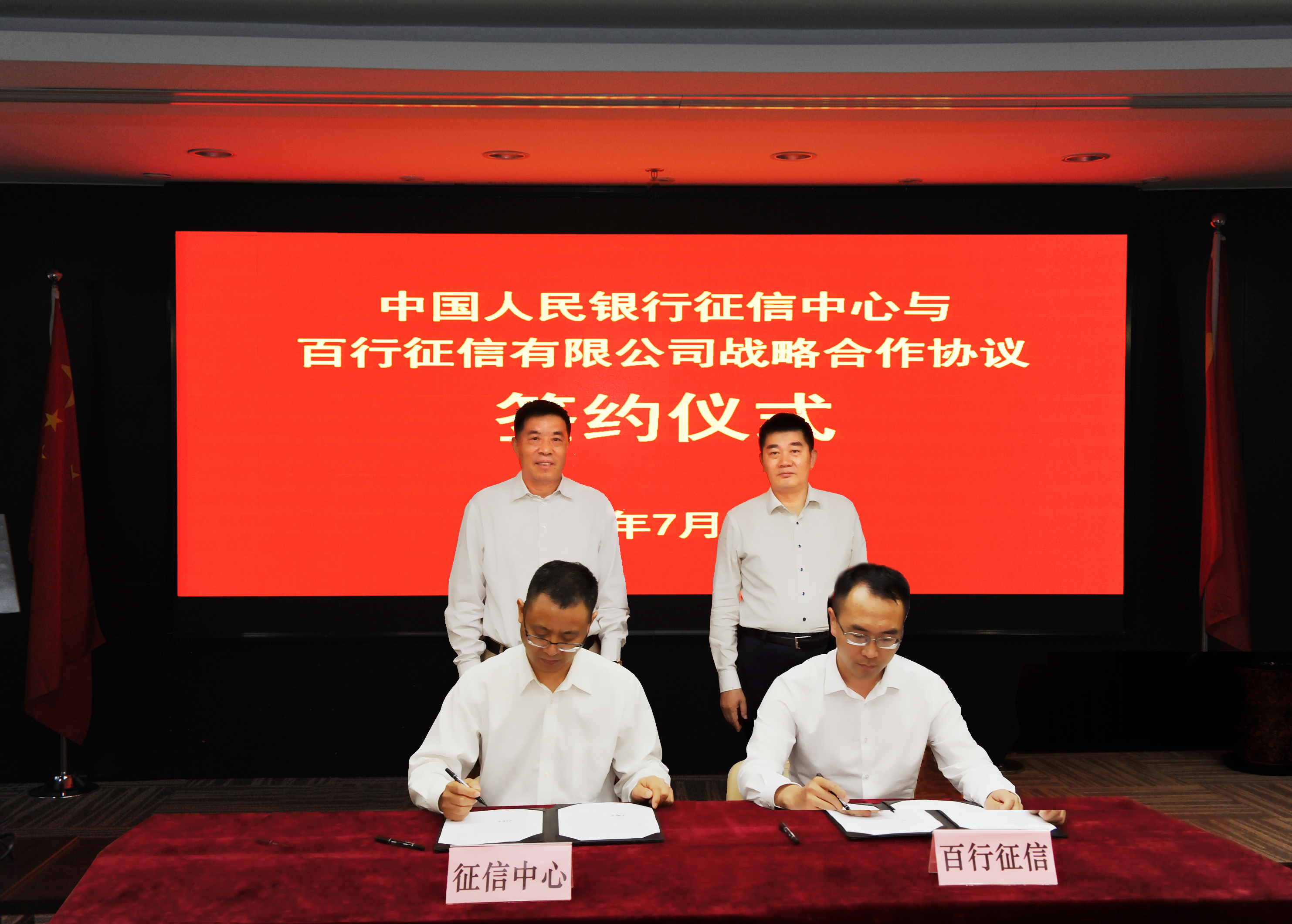
On July 17, 2020, the Credit Reference Center (CRC)of the People’s Bank of China(PBOC) and Baixing Credit Co., Ltd. (Baixing Credit) formally signed a strategic cooperation agreement. Jianhua, Chen Secretary of the Party Committee of CRC, and Huanqi, Zhu Chairman of Baixing Credit, attended the signing ceremony. Zhenzhong, Wang deputy director of CRC, and Pengpeng, Liu vice president of Baixing Credit Information, signed the contract on behalf of both parties.

   According to the agreement, the two institutes will actively carry out credit reporting strategy, business, and technical cooperation research under the premise of compliance with laws and regulations and guaranteeing information security, and effectively play the role of “government + market” to jointly promote the prosperity and development of my country’s credit reporting market. 

In accordance with the design of the PBOC on China’s credit reporting market, the two institutions have achieved differentiated development, adhered to the principles of mutual benefit and gradual progress, and jointly explored innovations in cooperation mechanisms, enhanced the innovation capabilities of both institutes’ credit reporting services, and jointly created and maintained a fair market environment. At the same time, both parties will strictly implement the relevant provisions of the 《Regulations on the Management of Credit Reporting Industry》to effectively protect the rights and interests of information subjects (Especially Consumers).

PCCM Review: It’s a good news. The development of China’s credit reporting industry requires resource integration, cooperation and sharing.

About The Credit Reference Center(CRC), the People’s Bank of China

CRC was established in March 2006 with the approval of the State Commission Office of Public Sectors Reform. As an independent credit information service institution under the People’s Bank of China (PBC), the Center’s mandate is to establish, operate and maintain the national centralized commercial and consumer credit reporting system.

About Baihang Credit

img

Baihang Credit Co., Ltd. is the first company in China that has obtained a consumer credit reporting business license. It is organized by National Internet Finance Association of China and eight market institutes, including Zhima Credit, Tencent Credit, Qianhai Credit, Kaola Credit, Pengyuan Credit, Zhongchengxin Credit, ZhongzhichengCredit Report, and Huadao Credit. The company was incorporated in Shenzhen on March 19, 2018 and settled in Futian, with a registered capital of 1 billion Yuan.

Resource Link

CTOS,Malaysia, Acquires CIBI Information Inc. Philippines

2020-07-20

UALA LUMPUR: CTOS, Malaysia’s leading credit reporting agency, has today announced its acquisition of CIBI Information Inc (CIBI), the Philippines’ first and most established credit reporting agency.

CTOS said the acquisition marked its first regional investment, and a critical first step in its expansion into Asean.

“CTOS has cemented its position as Malaysia’s leading credit reporting agency, with a broad suite of innovative products and services developed in Malaysia over our 30-year history.

“This acquisition is a first key step towards bringing our products, solutions and knowledge across Asean,” CTOS group chief executive officer Dennis Martin said in a statement today.

He said the deal was strategic, both in terms of the company and the market.

“While the fintech scene in the Philippines is active, credit bureau services are still at their infancy, creating a gap that needs to be filled as the country’s adult population of over 60 million embraces new financial products and services.”

There is significant room for growth, with CTOS projecting topline growth of between 20-30 per cent compounded annual growth rate at CIBI over the next five years.

CIBI president and CEO Marlo R. Cruz said the deal would allow it to benefit from CTOS’ resources, technology and vast experience to effectively expedite its goal of supporting the unbanked/underbanked, micro-SMES and the direct-to-consumer market segments in the Philippines.

In terms of talent and knowledge, Martin believes that the transfer will be mutually beneficial.

“CIBI is traditionally a business and people information provider, and they are also heavily involved in employment vetting, which is a sector that is new to us.

“As a local Filipino” company, they also have invaluable insights to their market that multinationals don’t,”

Brahmal Vasudevan, founder and CEO of private equity firm Creador, majority shareholder in CTOS, said its aim when investing in CTOS in 2014 was to make Malaysia a centre of excellence for credit reporting in Asean.

PCCM Review:

(1) The cross-border M&A of consumer credit reporting agencies occurred between emerging market countries, rather than the traditional mergers and acquisitions of European and American credit reporting agencies in emerging market countries.

(2) Mergers and acquisitions between institutions are relatively common in the field of consumer credit reporting. Through mergers and acquisitions, different resources are integrated to seize the market, and eventually the rapid development of personal credit reporting agencies is achieved.

(3) Mergers and acquisitions in China’s consumer credit reporting industry are relatively rare. In the future, with the further development of marketization and the opening up of foreign investment, there may be occurrences.

Resource Link from BIIA

Resource Link from NST Business

Asian Credit|Equifax India Launches a New Microfinance Risk Score

By India Education Diary Bureau Admin   June 9, 2020

Mumbai: Equifax India, registered as Equifax Credit Information Services Private Limited (ECIS), today announced the launch of a new MFI Risk Score, which is the only credit score in the industry that will enable MFI lenders to evaluate the creditworthiness of borrowers in a more holistic manner.

“Microfinance has an important role in enabling access to credit to the needy in the financial inclusion program” said KM Nanaiah, Managing Director, Equifax Credit Information services Ltd. and Country Leader, Equifax India and MEA. “The MFI industry is facing new challenges due to Covid-19 and lockdown. Given this scenario, we have developed MFI risk score using past credit information of the customer such as tenure, sanction amount, balance along with the previous payment history on the loans availed. The score is an excellent predictor of delinquent behavior both on existing and new loans.”

Using local data and global analytics expertise, the Equifax MFI Risk Score has been built to meet the needs of our MFI members. Equifax MFI Risk Score predicts the likelihood of a consumer becoming seriously delinquent (60+ days past due) within 12 months of scoring. The score development involved segmenting the population into 5 segments and around 5000 variables. The score ranges from 300 to 900.

Over a decade of presence in India, ECIS has brought many innovations in data and analytics to the Indian lending space. It is now a full service credit bureau offering its services to all segments of the lending industry – Retail Banking, MFI and Commercial.

Original Link

Asian Credit|Ant Credit Evaluation Co., Ltd. completed the filing of credit rating agencies

Source: Hangzhou Central Sub-branch, the People’s Bank of China, published at 17:02:00 on 15 June 2020

According to the Interim Measures on the Administration of Credit Rating Industry, jointly promulgated on 26 November 2019 by the People’s Bank of China, the National Development and Reform Commission, the Ministry of Finance, and the China Securities Regulatory Commission, the Hangzhou Central Sub-branch of the People’s Bank of China completed its filing of Ant Credit Evaluation Co., Ltd. (the Unified Social Credit Code: 91330100MA2H31531M, the global Legal Entity Identifier: 300300X64VL1SV92GM50).

Please note: completion of filing is not regarded as recognition or guarantee of credit rating agencies’ rating quality, technical methods, risk management, or internal control compliance.

Hangzhou Center Sub-branch, the People’s Bank of China

15 June 2020

Background: Public information shows that Ant Evaluation was established on 24 March 2020 with a registered capital of RMB 50 million, and it is a wholly-owned subsidiary of the Ant Group.

According to Zhou Weilin, the general manager of Ant Evaluation, after completing the filing, Ant Evaluation will start from the credit market under the existing credit rating regulatory framework, focus on small and medium-sized enterprises, and promote the application of credit rating results in the credit market.

Reference Link

Relevant News Link

Alliance of Yangtze River Delta (Business) Credit Reporting Agencies Established

Published at 10:05 on 15 June 2020, by the Financial News (Chinese)

The Alliance of Yangtze River Delta Business Credit Reporting Agencies was established recently, signalling important progress achieved with the construction of credit reporting system in the Yangtze River Delta.

The Alliance of Yangtze River Delta Business Credit Reporting Agencies is under the leadership of the PBoC headquarter, its branches in three provinces (Anhui, Jiangsu and Zhejiang), as well as one municipal city (Shanghai) in the Yangtze river delta region.

Six relevant companies launched the Alliance, including Shanghai Shengteng Science and Technology Co., Ltd. (Qixinbao, https://www.qixin.com), Jiangsu Provincial Joint Credit Reporting Co., Ltd. (http://www.js-zhengxin.com/Index/index), Suzhou Enterprise Credit Service Co. Ltd.(https://www.szqyzx.com.cn), Hangzhou Credit Reporting Co. Ltd.(No official website available), Zhejiang Huixin Science and Technology Co., Ltd.(http://www.idinfo.cn/index.action), and Anhui Credit Reporting Co., Ltd. (http://axzhengxin.com). [Some of the six companies have strong connections with major state–owned enterprises (SOE)]

The Alliance vows to be market-led, open and sharing, equal and mutually beneficial, and self-disciplined. It aims to explore and promote cross-regional development, utilization and allocation of credit information. 

In order to ‘improve the cross-regional credit information sharing mechanism, and facilitate industry coordinated development’, the Alliance will optimize the credit environment in the Yangtze river delta region, alleviate information asymmetry, and enhance the level of financial services in the Yangtze river delta region. 

For original Chinese news,please visit http://finance.eastmoney.com/a/202006151521373196.html

Credit Reference Center(CRC, PBoC) and the three commercial banks held a signing ceremony for the strategic cooperation of accounts receivable financing service platform

On June 5, 2020, Credit Reference Center(CRC,PBoC), Industrial and Commercial Bank of China(ICBC), Bank of Communications and China Everbright Bank held a strategic cooperation signing ceremony in Beijing for accounts receivable financing service platform.

Chen Yulu, Vice President of the People’s Bank of China, attended and delivered a speech. Wang Jingwu, Vice President of Industrial and Commercial Bank of China, Yin Jiuyong, Vice President of Bank of Communications, and Qu Liang, Vice President of China Everbright Bank, attended and introduced the experience.

This strategic cooperation is of great significance for better playing the role of a receivables financing service platform, improving the financing efficiency of small and medium-sized enterprises, alleviating the problem of financing difficulties in financing and promoting the stability of enterprises to secure employment.

中文链接

Research Report:Sesame (Zhima) Score: ‘Social Credit Score’ or FICO-like Credit Score?

Xinhai Liu; Ruowen Xu

Abstract

At the beginning of 2015, Sesame score was born out of the finance department of the Alibaba Group, now named Ant Finance. Sesame score was introduced to Chinese consumers as the first public credit score in China and was soon brought into widespread use. Sesame score examines consumers’ creditworthiness based on one’s personal characteristics, credit history, contract performance, and social network and behavioural preferences, by incorporating proprietary big data that goes beyond mere financial aspects.

During recent years, the construction of a social credit score in China has caught the attention of the media across the globe. However, it is rather confusing to distinguish between the three main types of consumer scores: Sesame score, Social credit score, and FICO-like credit score. In this paper, we will explore the differences between these three types of consumer scores.

Delving into the mechanism of Sesame score, this research will explore in detail how it operates and analyses how it differs from a traditional credit score. In addition, we will investigate the applications and performance of Sesame score, as the score is widely used by digital vendors to provide and tailor daily services to consumers, enabling ‘use first and pay later’ or ‘borrow items without deposit’ features. Sesame score has accelerated the boom of the sharing economy in China.

Moreover, Sesame score has been recognized as a tool for risk controlling i.e. the safeguarding of Internet finance, given that the national credit bureau (Credit Reference Center) is not open to non-regulated Internet finance platforms whose credit applicants usually lack of credit history. Meanwhile, various Internet finance platforms and digital vendors have found Sesame score useful. It is worthwhile to look at how Sesame score meets the Chinese risk appetite and how the market has come to recognize the reliability of such a score. This paper also evaluates Sesame score approach to risk controls.

The wide application of Sesame score in non-loan fields has caused controversy, related to issues of consumer privacy and use in marketing. This year, due to the regulation from the People’s Bank of China, Ant Finance announced that it had stopped its business activities regarding the application of Sesame score in the finance field; now one must ask: what is the next step for Sesame credit score? This paper discusses the future of Sesame score with special consideration being given to the concepts ‘all data is credit data’ and ‘all service is becoming credit service’.

Key words: Sesame score, Credit score, Social credit score, Internet finance

Note: The report was original published in Credit Scoring and Credit Control Conference XVI,2019-08-29, Edinburg,U,K

For the full version of this report, please send the E-mail to public@pccm.org.cn

Research Report: Development of Personal (Consumer) Credit Reporting Requires Market Force in China

Xinhai Liu

Abstract

Consumer credit reporting[1]is an important infrastructure for consumer finance and digital economy. As a product of the market economy, it is self-evident how important the credit reporting system is for the healthy growth of an economy and the stable operation of a financial market.

China’s consumer credit reporting did not start until the beginning of the century which was relatively late. However, as China emerges to be the world’s second largest economy, its domestic consumer finance became increasingly popular, and its credit market expanded. Consequently its consumer credit reporting agencies gradually attracted increasing attention. The central bank’s consumer credit reporting is efficient and highly capable of collecting data, however it mainly focuses on providing basic services. To provide services to the internet finance[2]sector, private credit reporting agencies, such as the Sesame Credit, ran their own trials to ‘test the water’. Such trials caused a lot of controversy whilst agitating the market. In addition, Baihang Credit, established at the beginning of 2018 by eight private credit reporting agencies as well as The National Internet Finance Association of China (NIFA), under the supervision and guidance of the Chinese central bank, being the People’s Bank of China (PBoC), have received attentions from all circles of society. 

The development of China’s credit reporting is different from that of developed European countries and the US, as in China it grew with the rise of the digital economy, consequently the involvement of many big data companies and internet companies drove the development with data and technology. The development of Chinese consumer credit reporting is also closely associated with the construction of a social credit system with Chinese characteristics. Meanwhile, China’s consumer credit reporting faces challenges, as the regulations on protecting personal information tightens globally, the development of a credit reporting market is influenced. This paper believes that the future development of China’s consumer credit reporting depends on the strength of market forces, after carefully examine the current complex and changing status of the Chinese consumer credit reporting, based on the circumstances.

Key words:Consumer Credit Reporting,Credit Score,  PBoC,  Sesame Credit, Baihang Credit 

Note: The original Chinese report  was  published in China Reform, 2019 (5), pp. 60-66.(http://cnreform.caixin.com/2019-09-10/101460687.html)

For the full report, please send the E-mail to public@pccm.org.cn.

Author Bio

Dr. Xinhai Liu is the  Deputy Director-General at the Professional Committee of Credit Management (PCCM), China Mergers & Acquisitions Association (CMAA). He is also a part-time researcher at the Center of Finance Intelligence Research, Peking University. 

Dr. Xinhai Liu is heavily involved in the R&D of Fintech, his focus covers policy, industry front and application algorithm. His book Credit Information Service and Big Data was published by the CITIC Press, a renowned publishing house in China. Dr. Liu is currently working on financial network analysis, alternative data based credit scoring, the application of AI and big data in finance. Meanwhile Dr. Liu owns several patents with his team on Fintech and AI.

Dr. Xinhai Liu obtained his PhD from the Katholieke Universiteit Leuven (K.U. Leuven) in 2011. After working in Belgium, Dr. Xinhai Liu worked in the Credit Reference Center at the People’s Bank of China as an associate researcher on credit risk management, where he conducted financial researches. He was a visiting scholar to the London School of Economics and Political Science (LSE).

Dr. Xinhai Liu has published academic papers in the world-level journals such as IEEE TKDE and IEEE PAMI and hosted several national research fundings on finance data analysis. 


[1]The international term for personal credit system is consumer credit system, however in China it is called personal credit system, therefore in the Chinese text personal credit system is used.  

[2]Internet finance is a new type of financial business model with which traditional financial institutions and internet companies conduct financing, payment, investment, and information intermediary services usingthe internet and information & communication technology.The term is quite popular in China in recent years, a typical product is P2P online lending. However, it has been replaced by a new word FinTech. (Xie, P., Zou, C. and Liu, H.(2020) Internet Finance in China: Introduction and Practical Approaches, Routledge)